
This guide explains how to prepare your website for AI-driven search so your content becomes a reliable source for large language models and generative engines.
For a detailed comparison of SEO, PPC, GBP, and AI search for contractor lead generation, see our breakdown: Contractor Lead Generation: SEO, PPC, GBP, and AI Search Compared.
Technical implementation is strongest when connected to visibility outcomes like zero-click search SEO and entity clarity through knowledge graph optimization for contractors.
You will see the outcomes to aim for, the concrete actions to take, and the technical methods that make facts machine-readable. Recommendations cover structured data and entity mapping, performance and crawl budget priorities, trust signals for automated citation, audit workflows to find gaps, and metrics to measure impact and risk.
Expect tradeoffs where richer schema and heavier data integrations improve LLM citation potential but increase development complexity and maintenance burden. A focused approach addresses constraints like crawl budgets, schema versioning, and the need for authoritative source links. One clear milestone is aligning around the five core pillars that govern machine consumption and citation behavior.
Start by grounding the core definitions that reshape how you prepare content and backend systems for LLM citation so you can move from theory to practical readiness.
Defining Technical SEO for AI Search and GEO
For the strategy layer behind this technical work, see our contractor guide to Generative Engine Optimization (GEO).
What is Technical SEO for AI Search?
Technical SEO for AI search involves optimizing a website’s infrastructure so large language models (LLMs) can easily crawl, parse, and ingest its data. Unlike traditional search, which focuses on indexing for a results page, AI search requires your content to be "digestible" for Retrieval-Augmented Generation (RAG) systems.
At its core, this means moving beyond simple meta tags to provide deep semantic context. By using structured data and clean site architectures, home service businesses ensure that AI agents like ChatGPT or Gemini can accurately attribute information to their brand.
Understanding Generative Engine Optimization (GEO)
Generative Engine Optimization (GEO) is the specialized methodology used to improve a brand’s visibility within AI-generated responses. While traditional SEO optimizes for a list of links, GEO optimizes for the narrative synthesis that AI provides to the user.
For contractors and home service providers, GEO focuses on being the primary source of truth for local queries. This involves increasing your "cite-ability" by providing unique data, expert insights, and clear answers that AI engines can easily reference in their conversational summaries.
Key Differences Between SEO and GEO
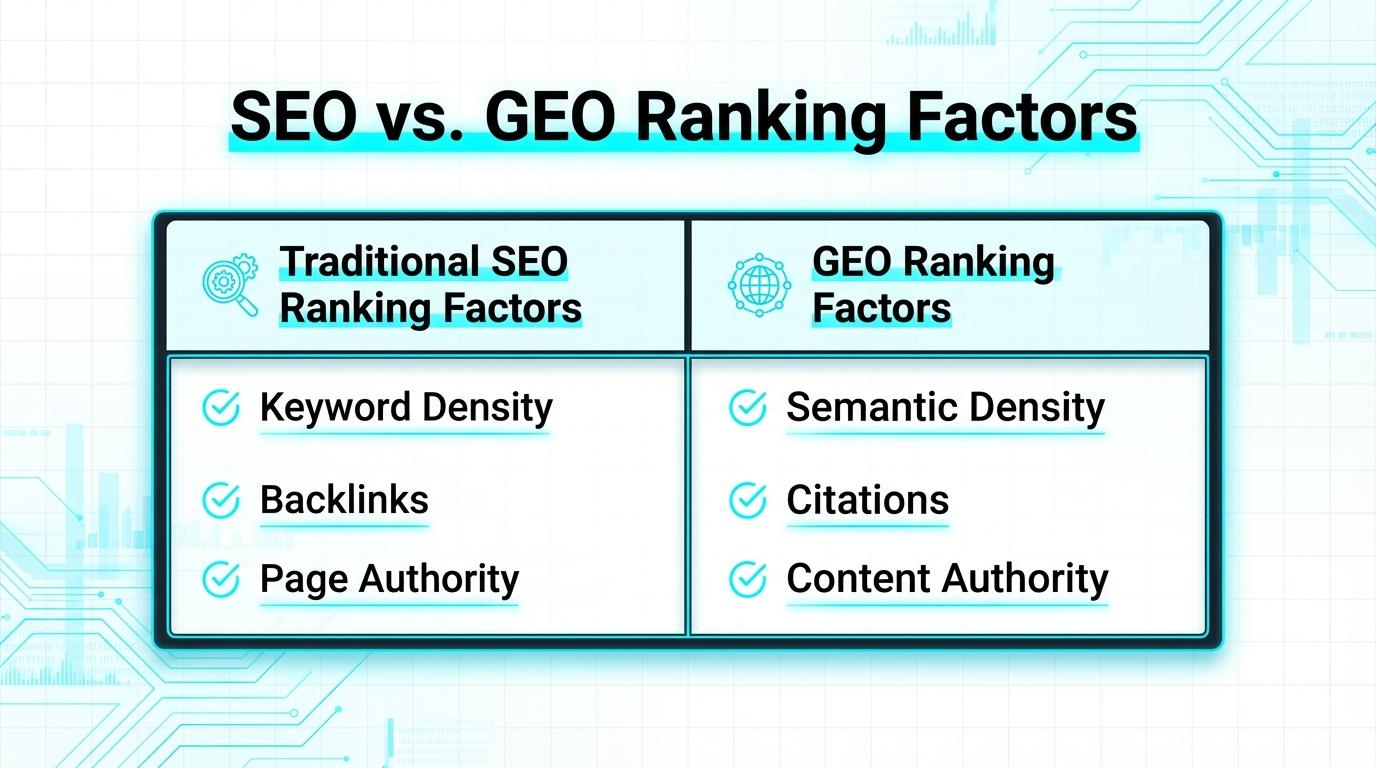
The shift from SEO to GEO represents a move from link-based relevance to citation-based authority. While backlinks still matter, AI engines prioritize how well your content answers a specific prompt and how frequently your brand is mentioned across authoritative datasets.

| Factor | Traditional SEO | GEO Ranking Factors |
| :— | :— | :— |
| Primary Goal | Ranking #1 on SERP for clicks | Being cited in AI-synthesized responses |
| Content Strategy | Keyword density and word count | Semantic density and factual accuracy |
| Authority Metric | Backlink profile and PageRank | Citation authority and brand mentions |
| User Intent | Matching keywords to pages | Solving complex conversational queries |
| Success Metric | Organic traffic and click-through rate | Inclusion rate in AI summaries |
For remodeling contractors and other home services, this evolution means that your technical foundation must support both humans and machines. Balancing these factors ensures your business remains visible as search behavior shifts from "searching" to "asking."
The Evolution of Technical SEO for Generative Systems
The transition from traditional search to generative AI has fundamentally redefined the "technical bar" for website performance. While legacy SEO focused on helping crawlers find and index pages for a list of ten blue links, Generative Search Experience (SGE) and AI Overviews (AIO) require a shift toward data digestibility. It is no longer enough to be indexed; your technical infrastructure must enable AI models to synthesize your content into a coherent summary.
The Impact of Google SGE and AI Overviews
Google’s transition from a search engine to an "answer engine" through AI Overviews has moved the goalposts for technical health. In the legacy environment, a technically sound site was one that passed Core Web Vitals and had a clean XML sitemap. In the generative era, the focus has shifted toward contextual relevance and information density.
AI summaries pull from high-authority fragments across the web. If your site’s technical structure is fragmented or your content is buried behind heavy JavaScript, generative systems may struggle to attribute your data as a source. To remain visible, home service businesses must prioritize a lean, highly readable technical stack that allows Google’s LLMs to extract key business facts—like service areas, pricing, and specific expertise—instantly.
How Technical SEO is Shifting for AI Systems
Modern technical SEO is less about "pleasing the bot" and more about building a machine-readable knowledge base. Traditional SEO was flat, but AI search is multidimensional. To navigate this new landscape, contractors must align their sites with The 5 Pillars of Technical AI Search Optimization to ensure their brand remains the primary source for local queries.
The most significant shift involves moving toward semantic site structures. This approach organizes data so that AI can understand the relationships between different entities (e.g., your business, the services you provide, and the locations you serve).
Key shifts toward semantic site structures include:
- Implementation of Nested Schema: Moving beyond basic "LocalBusiness" schema to include specific "Service" and "AreaServed" types that link together logically.
- Breadcrumb Optimization: Using clear, hierarchical paths that define the relationship between categories and sub-services.
- Content Chunking: Breaking long-form content into logical H2 and H3 blocks with descriptive IDs, making it easier for AI to cite specific sections.
- Entity-Based Internal Linking: Using descriptive anchor text that connects "Plumbing Services" directly to "Emergency Water Heater Repair" to build a topical graph.
- Markdown Compatibility: Ensuring your CMS outputs clean HTML that mimics the Markdown format favored by LLMs for faster processing.
The Influence of LLM Crawlers
We are entering an era of multi-crawler environments. Beyond the traditional Googlebot, site owners must now account for AI agents and LLM-specific crawlers such as GPT-Bot (OpenAI), ClaudeBot (Anthropic), and CCBot (Common Crawl).
These crawlers do not just index your site for search; they "consume" it to train or refine their responses. For home service professionals, this means the robots.txt file is now a strategic asset. You must decide whether to allow GPT-Bot access to your data so your business can be recommended within ChatGPT’s interface. Managing these permissions effectively ensures that while your content is protected, it remains accessible to the generative systems that your customers are increasingly using to find local help.
The 5 Pillars of Technical AI Search Optimization
Core Technical SEO Strategies for GEO
Generative Engine Optimization (GEO) represents the next frontier in digital visibility. Unlike traditional search, which focuses on keyword matching and backlink profiles, AI-driven search models prioritize information density, entity relationships, and contextual relevance. For home service providers, this means transitioning from simple crawlability to "machine readability." To succeed in this ecosystem, your technical SEO must be refined to help Large Language Models (LLMs) like ChatGPT, Claude, and Gemini synthesize your data into direct answers for users.
The 5 Pillars
To achieve high-authority placement within AI snapshots and citations, your site must adhere to these five fundamental technical pillars:
- Semantic Architecture: Your site’s structure must go beyond flat hierarchies. It requires a topical hub-and-spoke model that allows AI agents to identify the relationship between your core services (e.g., HVAC repair) and localized sub-entities (e.g., emergency furnace replacement in specific zip codes).
- Structured Data Enrichment: While traditional schema helps with rich snippets, AI-specific optimization utilizes advanced schema markups to define the specific attributes of your business entity, ensuring the LLM understands your service area, pricing models, and specialized certifications without ambiguity.
- Knowledge Graph Integration: This is the process of connecting your business to established digital entities. By mapping your data to the Google Knowledge Graph and other external databases, you provide a "source of truth" that AI engines use to verify your existence and authority within the home services industry.
- Citation Readiness: AI systems prioritize information that can be cross-referenced across multiple high-authority sources. Citation Readiness involves ensuring that your Google Map SEO data, directory listings, and technical N-A-P (Name, Address, Phone) metadata are identical across the web, reducing the "hallucination risk" for generative engines.
- Technical Trust Signals: LLMs are programmed to avoid recommending low-quality or insecure websites. Critical signals include HTTPS encryption, Core Web Vitals performance, and X-Robots-Tag configurations that explicitly allow (or disallow) specific AI crawlers like GPTBot to access your most valuable data assets.
AI-Specific Optimization Tactics
Beyond the foundational pillars, technical precision in quote integration and fact-checking is paramount. AI engines look for "verifiable claims." If your website states you are the "highest-rated plumber in Dallas," the technical backend must support this with linked reviews and third-party validation schemas.
Our SEO services prioritize the deployment of hidden metadata layers—content specifically formatted for machine consumption—that emphasize technical accuracy. This includes utilizing clear, concise language in your H1-H4 tags and ensuring that every technical claim is backed by a structured citation. By establishing this level of factual density, you move from being a "possible result" to a "primary citation" in generative answers.
As we master these pillars, the focus shifts to the implementation of the most critical bridge between your content and AI understanding: advanced schema frameworks.
Advanced Structured Data: The Language of LLMs
While human users consume content through visual design and narrative flow, Large Language Models (LLMs) and AI crawlers consume data through explicit relationships. In the context of Technical SEO for AI Search, structured data acts as a translator, converting your website’s unstructured text into a machine-readable format that can be instantly indexed into a Knowledge Graph. By providing clear, semantic clues, you ensure that AI agents don’t have to "guess" what your business does—they can verify it.
The Critical Role of Schema Markup in AI Search
AI-driven search engines like Google Search Generative Experience (SGE) and Perplexity rely heavily on structured data to build their internal knowledge bases. When you implement schema, you are effectively feeding knowledge graphs with "entities" rather than just keywords. This distinction is vital: an entity is a unique, well-defined thing (like your home service business), whereas a keyword is just a string of text. By utilizing Google Search Central: Structured Data Documentation, technical SEOs can ensure their site structure aligns with how Google identifies these entities across the web.
Essential JSON-LD Schema Types for LLMs
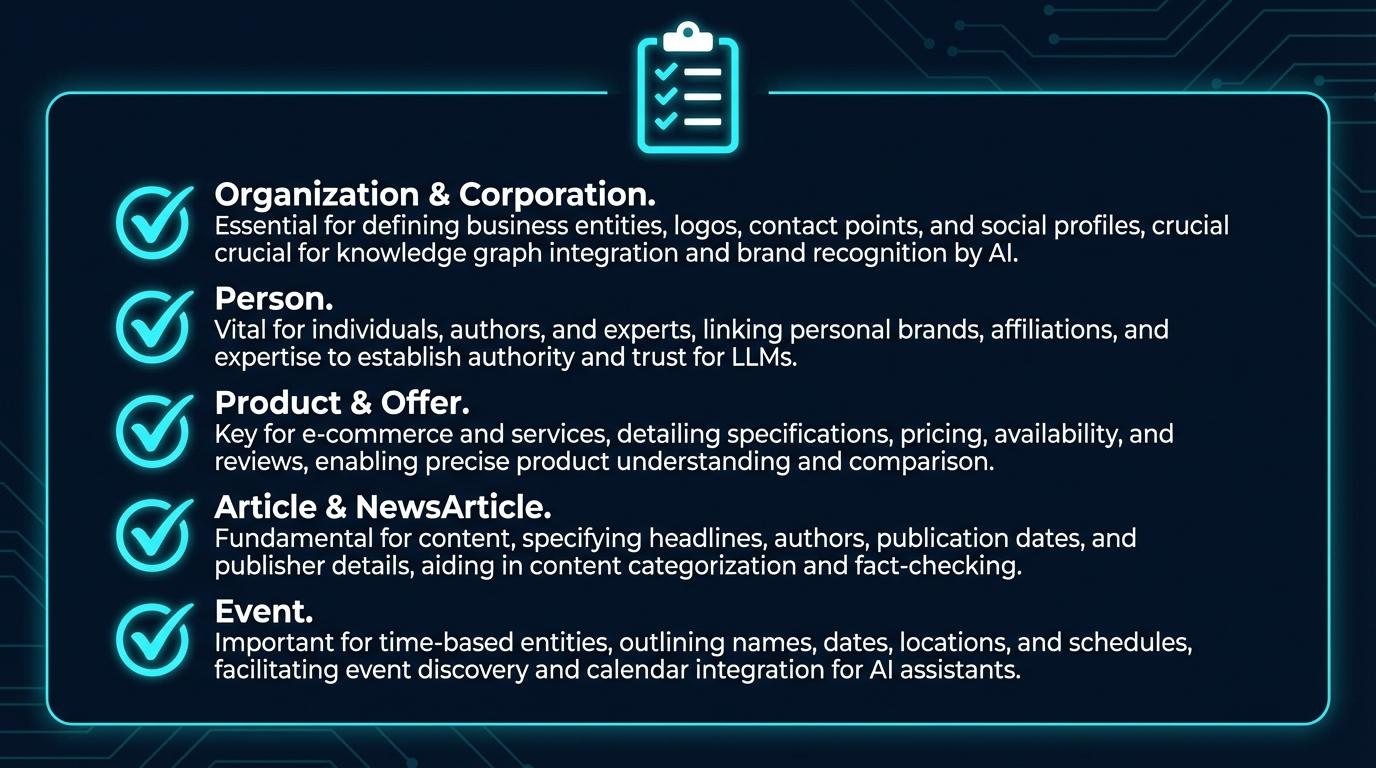
To excel in AI search, specifically for the home services sector, certain schema types carry more weight because they establish trust, authority, and location-based relevance.
Checklist of Top 5 JSON-LD Schema Types for LLMs:
- LocalBusiness: Defines your physical location, operating hours, and service area.
- Service: Explicitly lists the specific jobs you perform (e.g., "HVAC Repair" or "Roofing").
- Review: Provides social proof and star ratings that LLMs use to rank "best" or "top-rated" lists.
- Organization: Establishes your brand identity, logo, and official contact points.
- FactCheck: Used to verify specific claims, which is increasingly important for AI models prone to hallucinations.
For a deeper dive into specialized definitions, you should reference the Schema.org Vocabulary for Technical Entities, which serves as the global standard for these data structures.
Implementing Entity-Relationship Mapping
The most sophisticated layer of Technical SEO for AI Search involves defining how different entities relate to one another. This is achieved through specific properties that act as "bridges" between your website and the rest of the authoritative web.
The ‘sameAs’ Property
The sameAs property is used to tell an LLM that "this entity on my page is the exact same thing as this entity on another highly authoritative site." For a home service business, this usually links your website to your Google Business Profile, Yelp page, or Better Business Bureau listing.
The ‘about’ Property
The about property is used to specify the primary subject of a piece of content. If you have a blog post about "The Benefits of High-Efficiency Heat Pumps," using the about property to link to the "Heat Pump" entity on DBpedia or Wikipedia helps the LLM understand the technical context of your expertise.
Example JSON-LD Snippet for Entity Mapping:
`json
{
"@context": "https://schema.org",
"@type": "LocalBusiness",
"name": "Growth Pro HVAC Services",
"sameAs": ,
"about": {
"@type": "Service",
"name": "Energy Efficient HVAC Installation"
}
}
`
By explicitly mapping these relationships, you reduce the "noise" for the AI crawler and increase the probability of your business being cited as a primary source in AI-generated answers.
Technical Performance: Crawlability and Speed in an AI World
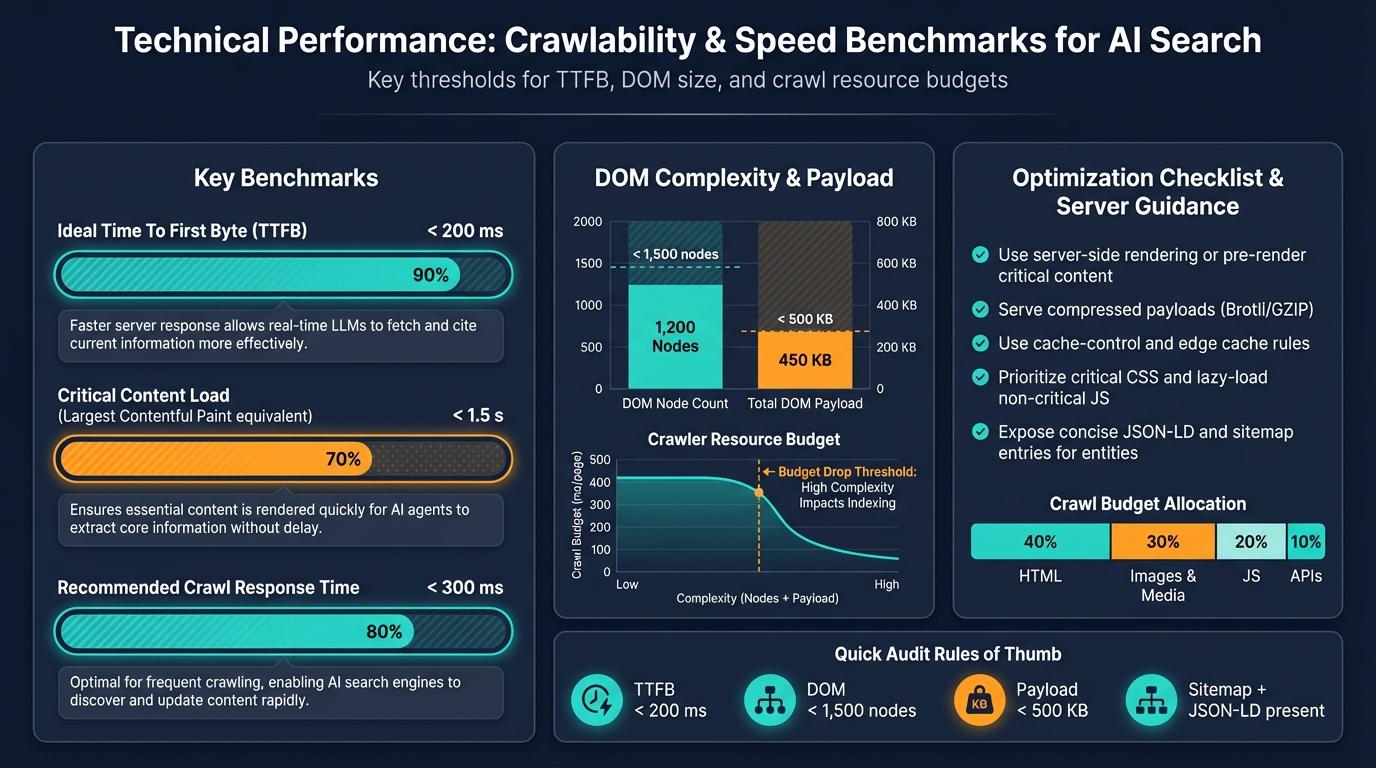
In the era of traditional search, speed was primarily a user experience metric and a minor ranking factor. However, for Technical SEO for AI Search, performance is a foundational requirement for citation. AI agents—such as SearchGPT, Perplexity, and Google’s Gemini—often operate in real-time, pulling data from the live web to answer a user’s query. If your site is slow to respond, these agents will bypass your content in favor of a lower-latency source that allows them to generate a response faster.
How Page Speed Affects AI Search Visibility
AI models require high-speed access to data to maintain their "real-time" feel. When an AI agent performs a "live search" to fulfill a request (like finding an available HVAC repair service nearby), it prioritizes sources that offer the least resistance. High latency acts as a barrier, often resulting in your site being omitted from the generated response entirely.
To remain competitive in Answer Engine Optimization (AEO), your site must exceed standard performance metrics. AI agents aren’t just looking for content; they are looking for efficiently deliverable content.
If you are mapping technical priorities to channel strategy, our AEO vs SEO comparison explains where classic SEO ends and answer-engine optimization begins. For the performance side of that technical foundation, see our Core Web Vitals for contractors guide.
| Performance Metric | AI-Optimization Target |
| :— | :— |
| Time to First Byte (TTFB) | Under 200ms |
| DOM Size | Under 1,500 nodes |
| LCP (Largest Contentful Paint) | Under 1.2s |
| Code-to-Text Ratio | Minimizing bloat for agent parsing |
Crawlability and Resource Budget for AI Agents
Much like Google’s crawl budget, AI agents have a "resource budget" when scanning your site. If your page is weighed down by excessive scripts, heavy images, or complex HTML, the agent may time out or only partially parse your information. This is particularly critical for local SEO for contractors, where the AI needs to quickly identify your service area, reviews, and contact details to recommend you to a local lead.
Clean, semantic code is no longer optional. Every unnecessary line of JavaScript is a distraction for an AI agent trying to map your content to a user’s intent.
Improving Site Architecture for AI Navigation
AI agents navigate differently than humans. They prefer flat, logical architectures that allow them to discover all relevant pages without digging through layers of sub-directories. A disorganized site structure can lead to "orphan pages" that AI agents never find, even if they are linked in your XML sitemap.
To optimize your navigation for AI discovery, follow these structural best practices:
- Flatten your site hierarchy: Ensure that your most important service pages are no more than two clicks away from the homepage.
- Implement comprehensive internal linking: Use descriptive, keyword-rich anchor text to help AI agents understand the relationship between different pages on your site.
- Utilize clean URL structures: Avoid dynamic parameters that can confuse crawlers; use readable, static URLs that mirror your site’s hierarchy.
- Audit your site architecture: Regularly use contractor SEO services to identify and fix crawl errors or broken links that could stall an AI agent.
By prioritizing these technical benchmarks, you ensure that your home service business is not just visible to humans, but easily digestible for the AI systems that are increasingly making the "first click" on their behalf.
Building Digital Trust: Technical EEAT for Machine Credibility
In the era of Generative Engine Optimization (GEO), trust is no longer just a subjective feeling experienced by a human reader; it is a programmatic requirement for LLMs. While traditional SEO focuses on the "editorial voice" to demonstrate Experience, Expertise, Authoritativeness, and Trustworthiness (E-E-A-T), technical SEO for AI search focuses on structured validation. AI models prioritize content that can be cross-referenced against known, high-authority entities in their training data and real-time knowledge graphs.
Trust Signals (EEAT) in the Context of AI Search
For an AI to cite your home service business as a reliable source, it must resolve the "identity" of your brand across multiple digital touchpoints. LLMs treat citations and structured metadata as a verification layer. When an AI agent scans a page, it looks for technical markers that confirm the information is backed by a legitimate entity.
This goes beyond keyword density. AI search engines utilize Knowledge Graph mining to determine if a brand is a recognized authority. If your technical infrastructure fails to explicitly define your relationship to your industry, professional organizations, and geographical location, you risk being filtered out in favor of competitors who have a "thicker" digital footprint verified through code.
Technical Implementation of Author Profiles
Authoritative content must be tied to a verifiable human or organization. For home service providers, this means linking the person writing the advice (e.g., a Master Plumber or Lead Electrician) to their professional credentials via schema markup. This creates a "trust loop" that AI models can follow to verify expertise.
To implement this effectively, use the Person Schema and include the following properties:
- `sameAs`: Use this array to link to the author’s professional social profiles (LinkedIn), state licensing boards, or industry certifications (e.g., NATE for HVAC).
- `jobTitle`: Explicitly state the professional role.
- `alumniOf` or `memberOf`: Link to trade schools or professional associations like the PHCC.
- `knowsAbout`: Use this property to list specific technical topics the author is an expert in, such as "Tankless Water Heater Installation."
By defining these relationships in the JSON-LD, you provide a roadmap for LLMs to validate that the content is produced by a credentialed expert, rather than an unverified AI script.
Verifying Data Accuracy for AI Citation
The foundation of technical trust for local businesses is the consistency of NAP (Name, Address, Phone) data. For LLMs, discrepancies in this data are signals of low reliability. If your website lists one phone number, but your SEO for Home Services strategy results in a different address on Google Maps or Yelp, the AI may experience "entity confusion."
To ensure machine credibility, your technical layer must act as the Single Source of Truth:
- LocalBusiness Schema: Deploy comprehensive LocalBusiness or HomeAndConstructionBusiness schema on every page, ensuring the NAP data matches your Google Business Profile exactly.
- Organization Schema: Define the parent entity of the brand to help AI models understand your business structure.
- Coordinate Accuracy: Include geo coordinates (latitude and longitude) within your schema to provide precise location data that AI models use to determine local relevance.
When your technical metadata is perfectly aligned with your off-site citations, you reduce the "noise" for the AI, making it significantly more likely that your business will be the one recommended to a user searching for a local contractor.
Implementing a Technical AI Readiness Audit
To dominate in Generative Engine Optimization (GEO), you must move beyond traditional "keyword" audits and start viewing your site through the lens of a Large Language Model (LLM). A technical AI readiness audit ensures that AI agents can not only crawl your site but also synthesize your data into accurate answers for users.
How to Audit Site Structure for AI Readiness
A site structure optimized for AI focuses on semantic connectivity and data accessibility. Follow this step-by-step workflow to evaluate your technical foundation:
- Map Your Information Architecture: Ensure your site uses a shallow hierarchy. AI crawlers favor content that is reachable within 2-3 clicks from the homepage. Use a flat site structure to minimize crawl depth.
- Verify Schema Markup Implementation: Use the Schema Markup Validator to ensure every service page has JSON-LD Structured Data. For home service businesses, prioritize LocalBusiness, Service, and Review schemas.
- Audit Internal Link Context: AI models use internal links to understand the relationship between topics. Ensure your anchor text is descriptive and that related services (e.g., "Emergency Plumbing" and "Leaking Pipe Repair") are linked to create a strong topical cluster.
- Check Content Deliverability: Ensure your primary content is delivered in the initial HTML response. AI bots often struggle with heavy client-side JavaScript. If a bot can’t "see" the text without executing complex scripts, the content effectively doesn’t exist for the LLM.
Tools for GEO Technical Analysis
Traditional SEO tools are still valuable, but AI-specific auditing requires a more nuanced approach to simulation. Use these tools to see your site exactly as an AI agent does:
- Screaming Frog (User-Agent Testing): This is the gold standard for technical simulation. Configure Screaming Frog SEO Spider to mimic specific AI bots. Go to Configuration > User-Agent and enter specific strings for GPTBot (OpenAI), CCBot (Common Crawl), or Bingbot. This reveals if your site is inadvertently blocking the very crawlers that power AI answers.
- Custom GPT-based Auditors: You can build or use a Custom GPT designed to parse URLs. Provide the GPT with your URL and ask it to "Extract the core entities and service offerings as if you were preparing a training dataset." If the AI misses key details, your technical structure is likely obscuring them.
- Google Search Console (URL Inspection): Use the URL Inspection Tool to view the "Crawled Page" HTML. If the rendered HTML is missing your core service descriptions or NAP (Name, Address, Phone) data, you have a rendering gap that will hinder your contractor SEO services.
- Sitebulb: Excellent for visualizing link graphs. Use it to see if your high-value AEO (Answer Engine Optimization) pages are "orphaned" or isolated from the rest of the site’s authority.
Common Technical Gaps in AI Optimization
Even the most robust SEO for home services can fail in an AI environment due to these frequent technical oversights:
- Robots.txt Blockers: Many site owners accidentally block GPTBot or Common Crawl in an attempt to save bandwidth. Ensure your robots.txt file explicitly allows reputable AI crawlers to access your informational content.
- Inconsistent NAP Data: For AI to recommend a local business, it needs a "single source of truth." Inconsistent addresses or phone numbers across your site and third-party directories create "hallucinations" or cause the AI to omit your business entirely to avoid inaccuracy.
- Hidden Content in Tabs/Accordions: While great for UX, content hidden behind "click to expand" elements can sometimes be missed by simpler AI scrapers. Ensure all critical service data is present in the source code.
- Fragmented Schema: Applying schema to the homepage but neglecting individual service pages prevents AI from understanding the full scope of your expertise. Every page should have a defined entity via structured data.
Performance Metrics for Measuring GEO Success
The shift from traditional search engines to Generative AI has created a significant "data gap" in the SEO industry. Traditional tools, specifically Google Search Console (GSC), are currently insufficient for tracking Generative Engine Optimization (GEO) because they primarily report on standard blue-link impressions and clicks. To understand your performance in the era of AI Search, you must look beyond the standard dashboard and adopt a new set of metrics that prioritize brand authority and LLM citation frequency.
Tracking AI Citation Frequency
Unlike traditional rankings, success in GEO is defined by how often an LLM—such as ChatGPT, Perplexity, or Gemini—cites your website as a source of truth. Because there is no centralized "AEO Search Console," monitoring brand mentions requires a more manual, proactive approach.
We recommend conducting periodic "citation audits" by prompting generative engines with high-intent queries related to your services. You should track:
- Share of Model Voice: What percentage of responses for a specific category (e.g., "best HVAC repair in St. Louis") mention your brand?
- Source Placement: Are you listed in the primary answer, or relegated to the "related sources" sidebar?
- Contextual Accuracy: Is the AI correctly stating your service areas, pricing, or technical specifications?
Referral Traffic from Generative Engines
While LLMs are designed to provide direct answers, they also act as high-quality referral engines. When a user seeks deep verification, they click the citations provided in the AI response. This shifts the focus from Search Engine Results Page (SERP) CTR to Generative Citation CTR.
In your analytics platform (like GA4), you should monitor referral traffic specifically from domains like openai.com, perplexity.ai, and google.com (via SGE/AI Overviews). This traffic often exhibits higher engagement rates because the user has already been "pre-sold" by the AI’s summary of your expertise. At Growth Pro Agency, we view this referral traffic as a key indicator of whether your Technical SEO for AI Search is effectively feeding the models the right structured data.
Benchmarking AI Search Visibility
To quantify your technical success in the AI landscape, you must establish benchmarks that go beyond simple keyword positions. Because generative engines prioritize entities over keywords, your visibility is tied to the strength of your digital footprint.
Key indicators of GEO success include:
- Entity Sentiment Score: Is the AI speaking about your brand in a positive, neutral, or negative tone?
- Schema Validation Rate: The percentage of your core service pages that are successfully parsed and "understood" by LLM crawlers.
- Knowledge Graph Integration: Whether your brand information is consistently appearing in the AI’s underlying knowledge base.
- Citation Link Health: Ensuring the URLs cited by AI engines lead to high-converting, optimized landing pages rather than broken links or generic homepages.
By focusing on these emerging metrics, home service businesses can move past the limitations of traditional SEO and dominate the new landscape of Answer Engine Optimization (AEO).
*
Next Section:
The Evolution of Technical SEO for Generative Systems
The Intersection of Technical Precision and Operational Reliability
For a home service business, your digital presence is no longer just a "brochure"—it is a virtual reflection of your operational standards. In the era of Technical SEO for AI Search, the precision of your website’s backend directly signals the reliability of your physical services to search engines and AI agents. When your technical infrastructure is flawless, it builds a foundation of trust that converts casual searchers into loyal customers.
Bridging Infrastructure and Service Quality
In the world of AI-driven discovery, backend data acts as a digital mirror for your operational excellence. If an AI agent encounters broken links, slow load times, or conflicting schema data, it perceives a lack of operational reliability. Conversely, a clean, high-performance technical setup suggests a business that is organized and professional.
By maintaining high standards for technical SEO, you ensure that AI platforms like Google SGE or Perplexity can verify your business’s credentials, service areas, and real-time availability. This alignment between infrastructure and service quality ensures that when a homeowner asks for a "reliable emergency plumber," the AI has the technical evidence required to recommend your business with confidence.
How Technical SEO Supports Local Growth
Technical SEO is the engine that drives local demand capture in an AI-first environment. AI search engines prioritize "entity-based" results—meaning they look for verified businesses with clear, structured data that confirms their physical location and service capabilities.
By optimizing your technical tags and implementing advanced local SEO for contractors, you enable AI systems to:
- Pinpoint your exact service radius through localized structured data.
- Surface your business in conversational "near me" queries.
- Extract key details such as hours of operation, pricing, and specific service offerings directly from your code.
This precision ensures you are not just visible, but that you are the preferred choice for local homeowners at the exact moment their need arises.
Long-term Benefits of Technical AI Readiness
Investing in technical readiness today is about future-proofing your business against the rapid evolution of search. Traditional keyword matching is being replaced by semantic understanding; your website must be technically capable of participating in this dialogue.
Businesses that prioritize SEO for home services that includes technical AI optimization will experience:
- Sustainable Ranking Stability: As algorithms change, well-structured data remains a constant source of truth for AI.
- Increased Conversion Rates: Faster, more accurate technical performance leads to a better user experience, which directly correlates to higher booking rates.
- Competitive Advantage: While competitors focus on outdated tactics, a technically precise site captures the growing segment of AI-assisted search traffic.
Is your business ready to dominate the next generation of search? Don’t leave your growth to chance. Request a comprehensive AI Readiness Audit from Growth Pro Agency today and ensure your technical foundation is built for the future of the home service industry.
Technical SEO for AI Search FAQs
How does the robots.txt file impact AI model training and search visibility?
The robots.txt file serves as the primary control mechanism for determining which AI crawlers, such as GPTBot or CCBot, are permitted to access your data. Restricting these bots can protect proprietary information from being used in large language model training, yet it may also limit your brand’s visibility within generative search results. Carefully managing these directives allows you to maintain a balance between data privacy and the need for your authoritative content to be indexed by the agents powering modern search experiences.
Can AI search engines process content hidden behind interactive elements like accordions?
Modern AI crawlers are increasingly proficient at rendering JavaScript and identifying text within interactive elements like accordions or tabs. While they can often see this content, there is a risk that data requiring specific user interactions to load may be ignored during the initial crawl. To ensure your most important facts are captured for generative summaries, it is best practice to keep essential information in the primary HTML or clearly mirror it within your structured data markup.
What is the relationship between site latency and AI citation frequency?
Site latency is a critical factor in how often an AI engine chooses to cite your content as a source. Because generative systems need to process vast amounts of information quickly to generate real-time answers, they prioritize low-latency sources that provide immediate data access. High server response times can cause AI agents to timeout or bypass your site entirely, making speed a foundational requirement for securing a high citation frequency.
Are there specific meta tags required to indicate content is optimized for generative search?
There are currently no exclusive meta tags specifically for generative optimization, but standard directives like the robots meta tag still play a role in how snippets are used. The most effective way to signal your site is optimized for AI is through the implementation of detailed schema.org properties that define entities and their relationships. This technical labeling provides the clarity AI systems need to verify your data accuracy and authority. Understanding these technical nuances is the first step toward a broader evaluation of your digital infrastructure.
Maximize Your AI Visibility Today
Preparing your website for the future of generative search requires a precise evaluation of your backend infrastructure and data clarity. Our team provides a SEO services and technical assessments designed to pinpoint exactly where your site architecture or schema implementation might be failing to communicate with LLM crawlers. By addressing these technical gaps now, you ensure your brand remains a primary source of truth as search engines continue to evolve into complex generative systems.