The Ultimate Guide to Generative Engine Optimization (GEO) for Contractors
Generative Engine Optimization, or GEO, is the emerging blueprint for ensuring your contracting business earns authoritative citations within Large Language Model (LLM) responses, a critical shift from merely ranking number one on traditional search result pages. You must now understand that AI search tools prioritize accuracy and source authority, meaning the goal moves from gaining blue link clicks to becoming a trusted source cited directly by systems like Gemini, ChatGPT, and Perplexity.
This guide translates that complexity into actionable steps, detailing how to shift your content from keyword-focused articles to structured, data-rich assets that AI models can easily ingest and attribute. We cover the essential strategy components, the technical requirements for LLM readability, and the specific ways success looks different when measured against AI outcomes rather than old-world visibility metrics.
Prepare to restructure your digital foundation so that when homeowners ask generative AI for the best local contractor, your expertise is the source material the machine relies upon.
What is Generative Engine Optimization (GEO)?
Generative Engine Optimization (GEO) is a specialized digital marketing framework designed to enhance a brand’s visibility within AI-driven search environments. Based on foundational research from Cornell University, GEO involves optimizing content so that Large Language Models (LLMs) can effectively parse, synthesize, and cite your business as a top-tier solution for user inquiries.
The Mechanics of Generative Engines
Traditional search engines function as sophisticated directories, matching keywords to a list of URLs. In contrast, generative engines utilize neural networks—computational systems modeled after the human brain—to process vast amounts of data and generate unique, conversational responses. For a contractor, this means the engine isn’t just looking for your website; it is looking for verified authority and structured data it can use to “speak” confidently about your services. These engines prioritize information that is clear, authoritative, and easily digestible by their internal algorithms.
The primary engines currently shaping the GEO landscape include:
- ChatGPT: Developed by OpenAI, this model uses extensive conversational datasets to provide direct recommendations and is increasingly integrated into daily search habits.
- Perplexity: A “search-first” generative engine that prioritizes source citations, making it essential for businesses looking to earn direct traffic from AI responses.
- Gemini: Google’s native AI model, which powers the Search Generative Experience (SGE) and blends traditional search results with AI-synthesized overviews.
- Claude: Anthropic’s model known for its high ethical standards and technical precision, often used by consumers seeking detailed, nuanced information.
GEO vs. Traditional SEO: Key Differences and Synergies
From Ranking to Citation: A Shift in Search Logic
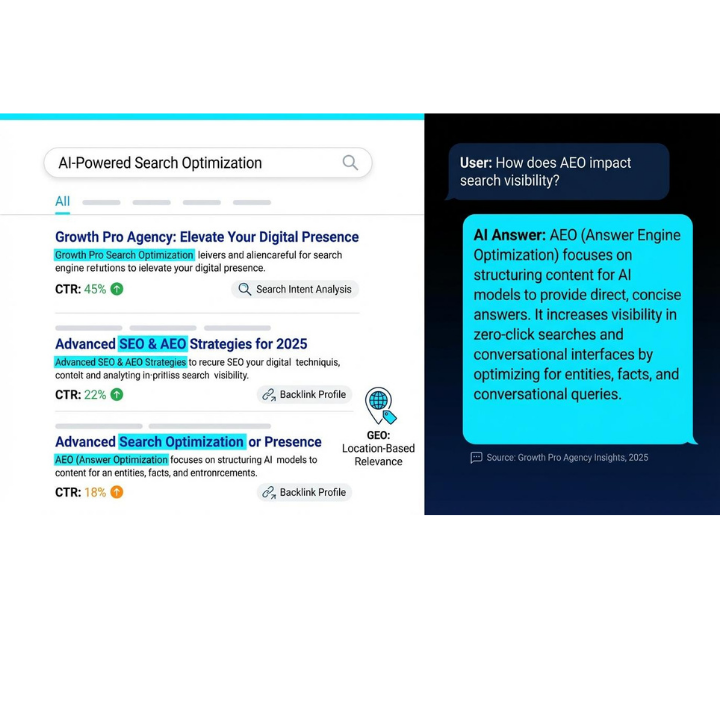
The fundamental difference between traditional SEO and generative engine optimization lies in the user’s end goal. In traditional search, the objective is to rank—securing a spot in the “10 blue links” to capture a click. In the era of AI, the objective shifts to citation.
When a homeowner asks an AI, “Who is the most reliable roofer near me?” the engine doesn’t just provide a list; it synthesizes an answer. If your business isn’t cited as a source within that answer, you effectively don’t exist in that search journey. GEO focuses on making your content “consumable” for Large Language Models (LLMs) so they can verify your expertise and present your brand as the definitive solution.
| Metric | Traditional SEO (Blue Links) | GEO (AI Citations) |
| :— | :— | :— |
| Primary Goal | High organic ranking (Position 1-3) | Becoming a cited source in AI responses |
| User Interaction | Scanning list of URLs and meta descriptions | Reading synthesized, conversational answers |
| Visibility Type | Static placement on a Search Engine Results Page | Dynamic inclusion in AI snapshots and summaries |
| CTR Potential | Concentrated on top 3 links | High-intent clicks from direct attribution links |
| Success Factor | Keyword density and backlink volume | Information density, brand trust, and verifiability |
Does Traditional SEO Influence GEO?
The short answer is: Absolutely. While the logic of how search results are presented has changed, the underlying data sources remain the same. LLMs and generative engines like Google’s SGE (Search Generative Experience) or Perplexity do not pull information from a vacuum—they crawl the same web index that traditional Google does.
The transition from domain authority to LLM trust is a natural evolution. Traditional SEO signals, such as high-quality backlinks and structured data, serve as the “credentials” that prove your site is a reliable source. For instance, a robust strategy for local SEO for contractors provides the foundational signals—like NAP consistency and localized content—that LLMs use to verify your physical presence and service area.
If your website lacks the technical health and authority required for traditional search, an LLM is unlikely to trust your data enough to cite it in a generative response. Therefore, GEO is not a replacement for traditional SEO, but rather an advanced layer that focuses on how those established signals are interpreted by AI.
The Core Components of a Generative Engine Strategy
To dominate in the era of AI-driven search, contractors must move beyond the traditional “keyword stuffing” of the past. A successful GEO strategy is built on a foundation of authoritative data and semantic relevance, ensuring that when an AI engine like ChatGPT or Google Gemini synthesizes an answer, your business is the logical conclusion.
Shifting from Keywords to AI-Prompt-Based Content
The most critical shift in this strategy is the move toward Intent Mapping. Intent mapping is the process of identifying the specific, conversational questions homeowners ask and structuring your content to provide the most direct, authoritative answer. Instead of targeting “AC repair,” you are targeting the intent behind “Why is my AC blowing warm air and how much will it cost to fix?”
For contractors, this approach serves as a strategic blueprint for content creation. By mapping your service pages to solve multi-layered problems, you position your brand as the primary solution for the AI to recommend. This ensures that your business doesn’t just appear in a list of results, but is featured as the trusted expert within the AI’s generated response.
To effectively map intent, your content should be optimized for three primary prompt categories:
- Informational Prompts: Users seeking education or DIY advice (e.g., “What are the signs of a cracked heat exchanger?”).
- Comparative Prompts: Users weighing different solutions or brands (e.g., “Tankless water heaters vs. traditional tanks for a 4-bedroom home”).
- Transactional Prompts: Users ready to hire immediately (e.g., “Best-rated emergency plumber in my area with 24/7 availability”).
Implementing these components requires a technical foundation similar to traditional search. For instance, our plumbing SEO guide demonstrates how niche-specific technical optimization sets the stage for advanced AI visibility. By combining these core components, your business becomes the “go-to” source for generative engines.
How to Optimize Content for AI Citations and E-E-A-T
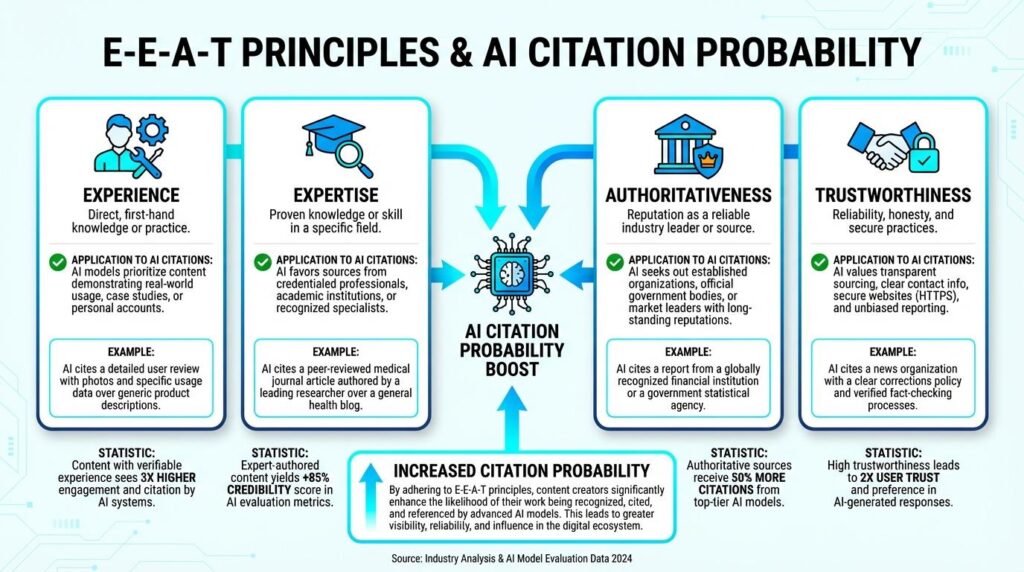
Generative engines are designed to provide accurate, helpful answers. To earn a citation in an AI-generated response, your content must satisfy both the user’s intent and the AI’s need for “grounded” information. This is where E-E-A-T (Experience, Expertise, Authoritativeness, and Trustworthiness) becomes the bridge between standard SEO and high-level generative engine optimization. AI models prioritize content that doesn’t just make claims but backs them up with verifiable data. For contractors, this means moving beyond generic marketing copy like “we are the best” and toward specific, data-backed technical insights.
Using Statistics and Facts to Improve Citation Probability
AI models such as GPT-4o and Claude 3.5 Sonnet are trained to look for patterns of factual correctness. When you include specific data points, you provide the “hooks” that an LLM needs to cite your page as a source. To improve your citation probability without cluttering your prose, follow the “Anchor Rule”: aim for one verifiable statistic or specific technical fact every 200–300 words. For example, instead of stating that “roofing repairs are expensive,” cite that “the average cost of a minor roof repair in 2024 ranges from $300 to $1,500, depending on the material and labor costs in your region.” This provides a clear, extractable fact that the AI can use to answer a direct user query. High-quality, localized SEO for contractors thrives on this level of detail, as it demonstrates geographic and industry expertise that AI models value.
Best Practices for Citing Sources and Establishing Authority
Building authority in the eyes of an AI requires a transparent “paper trail” of information. Contractors can establish this by following a rigorous verification and citation process that aligns with the latest SEO for home services best practices. Use the following steps to ensure every claim you make reinforces your E-E-A-T:
- Prioritize Primary Sources: Always link to original research, government data (such as the U.S. Bureau of Labor Statistics), or official trade associations (like NATE or ACCA).
- Verify Data Recency: Generative engines favor current information. Ensure that any statistics regarding pricing, building codes, or technology are no more than 24 months old.
- Use Exact Technical Terminology: AI identifies expertise through vocabulary. Instead of “heater parts,” use “heat exchanger” or “igniter probe” to signal depth of knowledge.
- Attribute Quotes and Estimates: If citing a localized price or a specific project outcome, attribute it to your company’s internal data (e.g., “Based on our 2024 internal service data for St. Louis HVAC installations…”).
- Audit for Consistency: Ensure your facts are consistent across all platforms—your website, Google Business Profile, and social media—as AI models often cross-reference these sources to determine trustworthiness.
- Implement Author Bylives: Ensure every technical article is attributed to a real person with a verifiable background in the trades, which is a core component of our contractor SEO services.
Technical SEO Requirements for Large Language Models
To succeed in generative engine optimization, your website must serve as a high-quality data source that AI agents can easily parse and verify. Unlike traditional search, where a user clicks a link to visit your site, LLM bots (like GPT-bot or CCBot) ingest your content to synthesize answers directly. If your technical foundation is weak, these models may skip your site entirely or, worse, hallucinate incorrect details about your business.
FAQ Schema and Structured Data for AI Agents
Structured data is the bridge between human-readable content and machine-understandable logic. For home service contractors, using specific schema types allows AI agents to confirm your service areas, pricing, and expertise without “guessing.” When an AI agent encounters Schema Markup, it treats the data as a verified fact, significantly increasing the chances of your business being cited in a generative response.
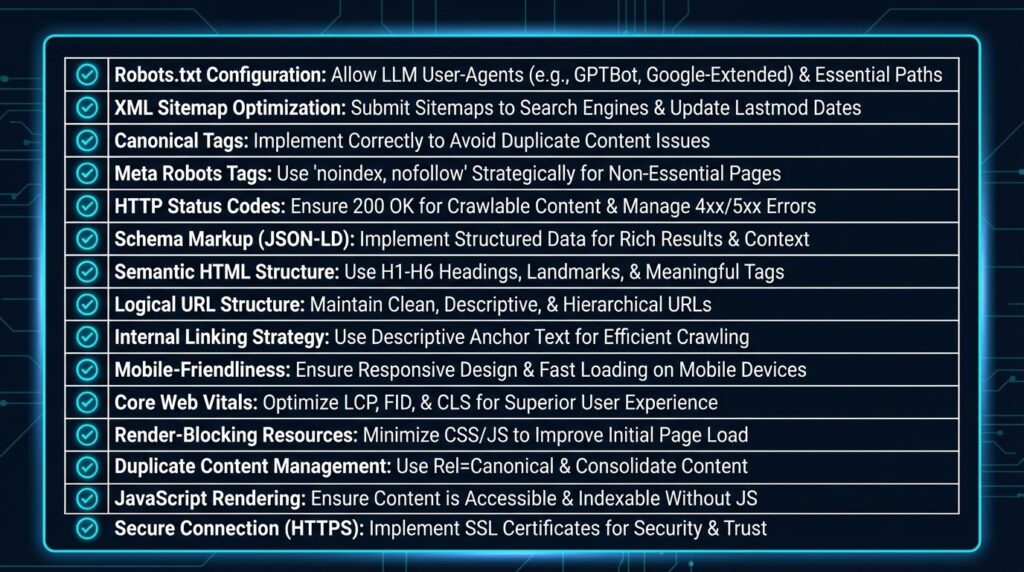
Technical SEO Checklist for AI Readiness:
- LocalBusiness Schema: This is non-negotiable for contractors. It must include your precise geographic coordinates, service area polygons, and verified phone numbers to ensure you appear in local AI-generated recommendations.
- FAQ Schema: AI agents frequently pull direct answers from FAQ sections. By marking up your most common customer questions, you provide “ready-to-eat” data chunks for the LLM to display.
- Product Schema: If you offer specific packages (e.g., “Standard HVAC Tune-up”), use Product schema to define the price, availability, and specific features of that service.
- BreadcrumbList Schema: This helps AI agents understand the hierarchy of your site and how different services (like “Plumbing” vs. “Emergency Drain Cleaning”) relate to one another.
- Review Schema: Verified third-party reviews help establish the “Trust” component of E-E-A-T, which LLMs prioritize when selecting which contractors to recommend.
Performance Metrics: Speed and Crawlability
The behavior of LLM bots differs from standard search engine crawlers in terms of resource allocation. AI models have massive “appetites” for data but limited crawl budgets for real-time information retrieval. If your site has poor crawlability—meaning it has broken internal links, a messy site structure, or slow server response times—the bot may time out before it can index your latest service updates.
Hire contractor SEO services that prioritize a “crawl-first” architecture to ensure your data is always fresh. Technical SEO for AI focuses heavily on site speed; faster load times allow bots to fetch more pages in a single session. This is critical for “Retrieval-Augmented Generation” (RAG), where the AI searches the live web for an answer. If your site doesn’t load within the bot’s strict latency window, your business is effectively invisible to the generative engine. For contractors, this means your technical SEO for home services must include optimized images, clean code, and a robust XML sitemap that explicitly guides AI agents to your most valuable conversion pages.
AI Content Creation and the Competitive Mention Gap
The rise of generative engine optimization (GEO) has introduced a new paradigm for home service marketing: it’s no longer just about where you rank on a results page, but whether an AI model “knows” you well enough to recommend you. Achieving this requires a strategic balance between high-volume content creation and maintaining a verified brand presence across the web.
Should Contractors Use AI to Write GEO Content?
For contractors, AI content creation is a double-edged sword. On one hand, tools like ChatGPT and Claude offer unparalleled efficiency, allowing you to generate blog drafts, FAQ sections, and service descriptions in seconds. This speed is essential for scaling the “information density” that generative engines crave.
However, the risks are significant. AI models are prone to hallucinations—they may confidently state incorrect local building codes, misquote safety regulations, or invent pricing structures that don’t exist. For a roofing or plumbing business, these inaccuracies can lead to liability issues and a total loss of consumer trust. To succeed in GEO, you must use AI as a high-powered assistant, not an autopilot. Every piece of content requires a “human-in-the-loop” to ensure it aligns with SEO for home services standards, prioritizing E-E-A-T (Experience, Expertise, Authoritativeness, and Trustworthiness).
Identifying and Closing the Mention Gap
The Mention Gap is a critical new metric in the world of AEO and GEO. It refers to the discrepancy between how often your competitors are cited, linked, or “mentioned” by an LLM compared to your own brand. If you ask a generative engine, “Who are the best HVAC technicians in Phoenix?” and it names three competitors but ignores you, you have a mention gap.
Closing this gap is about increasing your brand authority so that you become a primary data point in the LLM’s training set. This involves securing mentions on high-authority local directories, industry publications, and news sites.
To track your brand’s footprint and identify where you are falling behind, utilize the following tools and methods:
- Google Alerts: Set up monitors for your brand name, key employees, and specific competitors to see where they are earning new mentions in real-time.
- Brand24: A robust social listening tool that tracks mentions across the “hidden web,” including forums and social media, which are often indexed by AI models.
- Manual LLM Queries: Regularly “audit” LLMs by asking them questions related to your services (e.g., “Which plumber in [City] has the best warranty?”). This helps you see which brands the AI currently favors.
- Ahrefs/Semrush: Use these to monitor domain authority and backlinks, as LLMs often use link graphs to determine which sources are the most reliable.
- Mention.com: Provides competitive analysis to show you exactly which publications are talking about your competitors but not you.
Navigating Google SGE vs. Other Generative Engines
Understanding the landscape of generative search requires recognizing that not all engines operate on the same logic. While tools like ChatGPT or Claude are primarily Large Language Models (LLMs) designed for conversation, Google has taken a hybrid approach.
Google’s Search Generative Experience (SGE)—now evolving into AI Overviews—does not rely solely on its internal training data. Instead, it utilizes Retrieval-Augmented Generation (RAG). This process involves the engine “reading” the top-ranking web results in real-time and synthesizing an answer grounded in those facts. For home service contractors, this means that traditional SEO signals (like your Google Business Profile and local backlinks) still feed the AI’s “brain.”
Unlike “pure” LLMs that might hallucinate or use outdated data, Google’s hybrid model is tethered to its massive search index. To learn more about how Google integrates these technologies, you can explore their official documentation on SGE and AI in search.
Unique Optimization Needs for Search Generative Experience
Optimizing for Google Gemini (the engine behind SGE) requires a different tactical focus than optimizing for “answer engines” like Perplexity. The primary difference lies in how they attribute information, which directly impacts how a potential customer finds your business.
Citation Styles: Gemini vs. Perplexity
The way an engine cites your website determines your click-through rate (CTR) from a generative response. Use the table below to understand the nuances:
| Feature | Google Gemini (SGE/AI Overviews) | Perplexity AI |
| :— | :— | :— |
| Citation Format | Visual “Source Cards” and drop-down carousels located above or beside the text. | Inline numeric footnotes (e.g., [1], [2]) that link directly to the source. |
| Trust Signal | Heavily weights Brand Authority and Google Business Profile proximity. | Weights Source Diversity and the direct relevance of the text snippet. |
| User Path | Encourages users to “expand” the answer to see the supporting websites. | Provides a “Sources” list at the top of the response for quick verification. |
| GEO Strategy | Focus on Entity SEO and being the “best-known” local expert. | Focus on Direct Answer Optimization and providing data-rich technical content.
For contractors, this means that while Perplexity might cite you for a technical blog post about “how to repair a heat pump,” Google Gemini is more likely to cite you because you are a verified local entity with high E-E-A-T (Experience, Expertise, Authoritativeness, and Trustworthiness). To win in SGE, your content must be structured in a way that the AI can easily “clip” and attribute to your brand card.
Measuring Success: Tracking AI Traffic and Sentiment
Unlike traditional SEO, where success is often measured by a straightforward click from a search result to your website, Generative Engine Optimization (GEO) introduces the concept of “invisible traffic.” This occurs when an AI engine—like Google Gemini or ChatGPT—provides a complete answer to a homeowner’s query using your business data without the user ever visiting your site. For contractors, this means our reporting and analytics must evolve to capture the brand influence and sentiment that traditional tools often miss.
Currently, data attribution for AI-generated answers is limited. Most LLMs do not provide a “Search Console” that shows exactly how many times your business was mentioned in a private chat session. Therefore, we focus on proxy metrics that correlate AI visibility with real-world business growth.
Key Performance Indicators (KPIs) for GEO
To demonstrate the tangible value of GEO, we track a specific set of KPIs that go beyond simple page views. These metrics help contractors understand how effectively they are dominating the “AI headspace”:
- Brand Citation Frequency: The number of times your business name, phone number, or service area is cited as a recommended source within generative snapshots.
- Share of Model Voice (SoMV): A percentage-based metric that measures how often your brand appears in AI answers compared to your top local competitors for high-intent keywords like “emergency plumber near me.”
- Sentiment Score: Utilizing natural language processing (NLP) to determine if the AI is describing your services as “reliable,” “affordable,” or “highly-rated.”
- Assisted Conversion Rate: Tracking users who visit your site after interacting with an AI engine. While direct attribution is difficult, we monitor spikes in direct traffic and branded search that align with AI optimization campaigns.
- LLM Source Citations: Monitoring the frequency of links provided in the “Sources” or “Learn More” sections of Google Search Generative Experience (SGE) and Perplexity.
Main Challenges in GEO Integration
Integrating GEO into a standard marketing stack presents three primary hurdles. First is the Attribution Gap; because AI engines often provide immediate answers (zero-click searches), the value of being the “featured” expert doesn’t always show up in Google Analytics 4 (GA4) as a session. Second is Content Volatility, where AI models update their training data or fine-tuning parameters, causing your brand’s prominence to fluctuate without changes to your actual website. Finally, there is the Technical Barrier of Sentiment Control. Influencing how an AI “feels” about your brand requires a sophisticated web of lead conversion metrics and third-party sentiment signals (like reviews and news mentions) that are far more complex to manage than simple keyword density.
Integrating Technical SEO with Advanced AEO for Contractors
Technical SEO is no longer just about ensuring a search engine can “read” your site; it is about ensuring an AI model can verify your business. For home service contractors, the synergy between technical health and Answer Engine Optimization (AEO) is the difference between being a footnote and being the primary recommendation.
The Intersection of Site Architecture and AI Retrieval
The true power of Generative Engine Optimization lies in the marriage of structural integrity and contextual depth. While traditional SEO focuses on getting a page indexed by a crawler, AEO focuses on getting that page understood and trusted as a definitive factual source by Large Language Models (LLMs). When your site architecture is optimized with advanced Schema markup, you move beyond keywords and begin providing LLMs with the structured data they need to build a “knowledge graph” of your services.
At Growth Pro Agency, our advanced AEO strategies treat your technical foundation as a roadmap for AI agents. By eliminating data ambiguity and prioritizing site speed and mobile responsiveness, we build the LLM trust required for your business to be cited as the expert solution in AI-generated responses. This technical rigor ensures that when a homeowner asks a generative engine for the “best-rated HVAC repair near me,” your business isn’t just a search result—it’s the verified answer.
Frequently Asked Questions
- What is Generative Engine Optimization (GEO)?
Generative Engine Optimization (GEO) is the practice of optimizing your digital presence to ensure your business is cited and recommended by AI-driven search engines like Google’s AI Overviews, Perplexity, and ChatGPT. Unlike traditional SEO, which focuses on ranking in a list of links, GEO focuses on becoming the authoritative source that AI models use to generate their answers.
- Will GEO cause my website to lose traffic?
To be honest, yes, you may see a decrease in total sessions as “zero-click searches” rise—where the AI answers the user’s question directly on the results page. However, the traffic you do receive will be of significantly higher quality. Because the AI has already vetted and cited your business as a solution, the users clicking through are high-intent leads who are much further along in the buying journey. It is a shift from raw volume to high-conversion citations.
- How long does it take to see results from GEO?
GEO is a medium-to-long-term strategy. While you may see your brand cited in AI responses within a few weeks of updating your technical data and content, full authority building typically takes 3 to 6 months. The AI models must crawl, process, and “trust” your updated information before consistently recommending you over competitors.
- How does GEO work with my existing SEO strategy?
GEO does not replace traditional SEO; it enhances it. While SEO provides the foundation—such as a fast, mobile-friendly site and keyword-rich content—GEO layers on the contextual relevance and brand signals that LLMs require. Integrating GEO into your broader HVAC marketing strategies ensures you are visible in both the “blue links” and the AI-generated summaries.
Schedule a GEO audit today
GEO for Contractors FAQs
How long does it take to see results from GEO?
GEO results typically follow the timeline of LLM training cycles and search index updates. Since generative engines like Gemini or Perplexity refresh their knowledge bases at different intervals than standard Google crawls, you might see citations appear within a few weeks for fast-moving platforms, though establishing authority for complex contractor queries usually takes three to six months. Consistent brand mentions and structured data implementation accelerate this process by making your expertise easier for AI models to digest.
Can GEO replace traditional local SEO for HVAC or plumbing companies?
GEO functions as a powerful layer on top of your existing strategy rather than a replacement. While AI engines provide direct answers, local customers still rely on the Map Pack and localized organic results to find immediate help for emergencies. Integrating generative optimization ensures your business is the recommended solution in AI conversations, while traditional HVAC marketing strategies continue to capture high-intent search traffic from standard search engine results pages.
Will my website lose traffic if an AI answers the query directly?
The shift toward zero-click searches is a significant change in the digital landscape, but being the cited source in an AI response often leads to higher quality traffic. When an LLM recommends your business for specific plumbing or electrical expertise, the users who do click through are further down the sales funnel and more likely to convert. Focusing on becoming the authoritative source allows you to capture brand awareness and trust that simple keyword ranking no longer provides on its own.
Does the ‘Mention Gap’ tool work for local competitors?
Analyzing the mention gap is highly effective for identifying where local competitors are earning citations that you might be missing. By tracking how often local plumbing or HVAC brands appear in generative responses, you can adjust your content strategy to target the specific technical attributes or service areas the AI prioritizes. This data driven approach ensures your business remains a top consideration for homeowners seeking expert advice through AI assistants.
Dominate AI Search with GEO
The transition from simple search results to complex generative answers requires a proactive approach to maintain your competitive edge in the home services industry. Professional guidance ensures your brand is not just indexed but actively recommended by the next generation of search technology. By implementing a comprehensive SEO for contractors plan that integrates generative engine optimization, you position your business to capture high-value leads across all AI platforms.