
Optimizing your Google Business Profile (GBP) is the most direct path for home service contractors to dominate local search results, secure placement in the coveted Map Pack, and gain traction within emerging AI search experiences.
This comprehensive guide strips away guesswork, providing you with a technical, step-by-step framework that moves beyond simple profile setup. You will learn the critical distinctions between business listing types, how to enforce perfect Name, Address, and Phone (NAP) consistency across the web, and the precise methods for using visual content, like geo-tagged photos, to prove your service area. We will also detail strategies for consistently driving engagement through updates and testimonials, and show you how to proactively manage the Q&A section to capture specific customer needs. Finally, we map how these hyper-local signals create a foundation that influences your visibility in the newest generation of AI-driven search answers.
Begin by establishing the unshakeable technical bedrock of your profile to ensure Google accurately recognizes your business identity and service boundaries.
Foundational GBP Setup and Category Selection for Contractors
The foundation of any successful contractor marketing strategy begins with claiming and verifying your profile. Before you begin editing, ensure you follow (https://support.google.com/business/answer/3038177) to avoid immediate suspensions or flags.
Ownership gives you absolute control over the NAP (Name, Address, Phone) data that Google uses to rank you in the Local Pack. Verify your listing via postcard, phone, or video to unlock the full suite of GBP optimization tools.
Selecting Primary and Secondary Categories
Choosing the right categories is the single most influential factor for appearing in relevant contractor searches. Google uses these to determine which "bucket" of service providers you belong in.
- Primary Category: This must be your core trade (e.g., "HVAC Contractor" or "Roofing Contractor"). It carries the most weight for your ranking potential in the Map Pack.
- Secondary Categories: Use these to capture specific services like "Air Conditioning Repair Service" or "Water Damage Restoration Service." You can add up to nine, but only choose those that you actually perform to maintain relevance.
Step-by-Step Instructions for Duplicate Removal
Duplicate profiles dilute your SEO authority and split your customer reviews, which can severely damage your local rankings. Follow these steps to clean up your digital footprint:
- Search for Duplicates: Use Google Maps to search for your business name, old phone numbers, or previous addresses to identify "zombie" listings.
- Suggest an Edit: On the duplicate profile, click "Suggest an edit" and select the option for "Close or remove."
- Choose the Reason: Select "Duplicate of another place." Google will usually ask you to select the "correct" listing from a list; choose your verified profile.
- Request a Merge: If both listings have reviews, do not just delete the duplicate. Contact Google Business Profile Support to request a manual merge so you don’t lose your social proof.
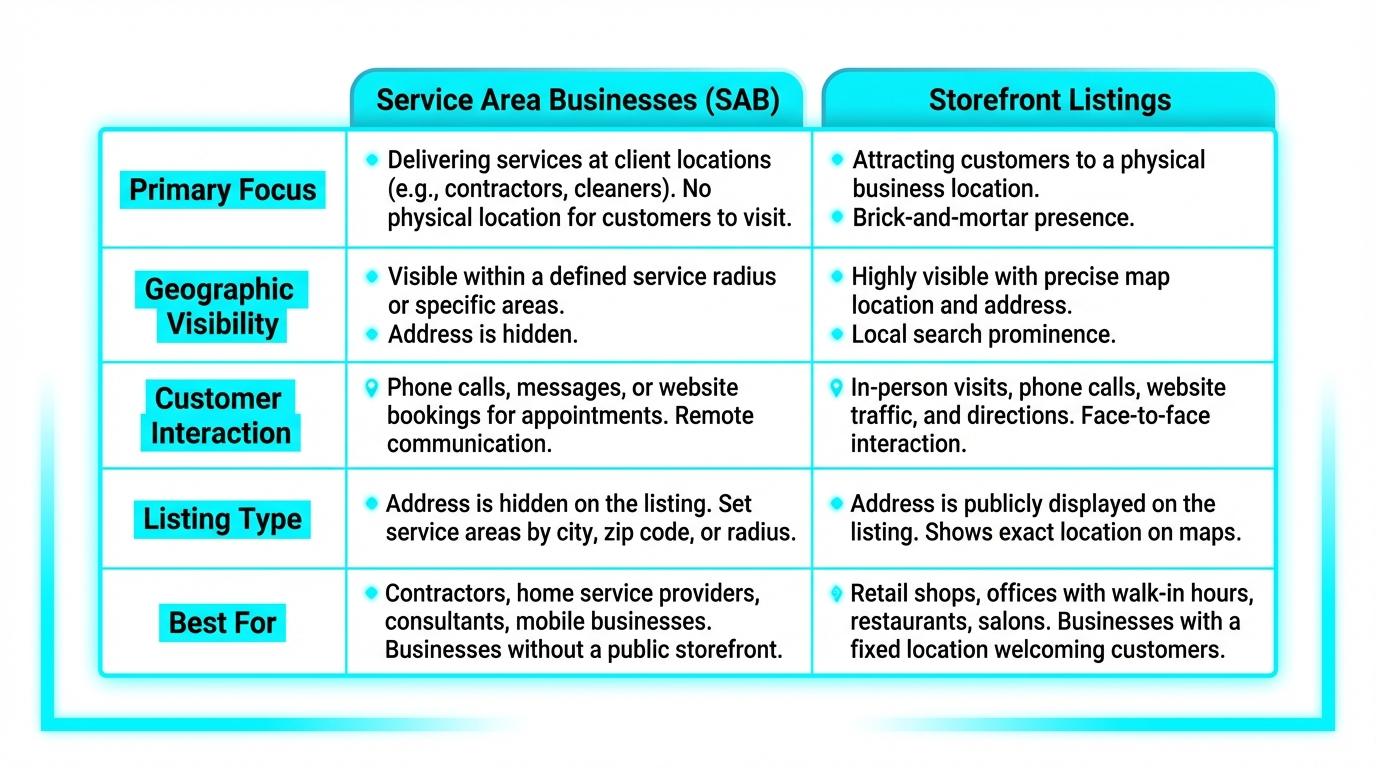
Once your profile is clean and correctly categorized, the next step is defining exactly where your work happens. This involves a crucial choice between setting a physical storefront or managing Service Area Business (SAB) settings to reach your local customers effectively.
Optimizing Service Areas vs. Storefront Listings
Choosing the correct business designation on your Google Business Profile (GBP) is one of the most critical technical decisions a contractor can make. It dictates how your business appears on Google Maps and determines which potential customers see your services. For most home service professionals, the choice falls between a Service Area Business (SAB) or a Storefront listing.
SAB vs. Storefront Impact
The primary difference lies in how Google treats your physical location. A Storefront listing is designed for businesses with a physical office or showroom where customers are greeted by staff during stated hours. In contrast, a Service Area Business is for contractors who travel to their customers’ locations—such as plumbers, roofers, or electricians—and do not serve customers at their own business address.
The choice you make affects your Map Pin visibility and how your address is displayed to the public. Failing to configure this correctly can lead to profile suspension or poor local rankings.
| Feature | Service Area Business (SAB) | Storefront Listing |
| :— | :— | :— |
| Address Display | Hidden from the public. | Publicly visible on the map and profile. |
| Service Radius | Defined by cities, zip codes, or counties (up to 2 hours drive). | Typically centered around the physical address. |
| Map Pin Visibility | No specific pin; shows a broad shaded service area. | Precise map pin at the physical location. |
| Verification Requirement | Physical address required for verification (but hidden). | Physical address required and must be a commercial space. |
Hybrid Business Configuration
Many contractors operate as a hybrid business. This occurs when you have a physical office or showroom where customers can visit to browse materials or sign contracts, but you also dispatch crews to perform on-site work.
In this scenario, you should display your address on your Google Business Profile while also defining your service areas. This allows you to capture local "near me" traffic at your office while signaling to Google that you serve a much broader geographic region.
However, ensure your office is staffed during business hours. If Google’s street view or a "Local Guide" suggests the office is just a residential home with no signage, you risk losing your storefront status.
Managing Geographical Reach
To maximize your local SEO for contractors, you must be strategic about how you define your boundaries. Google allows you to add up to 20 service areas per profile. Instead of choosing one massive radius, it is often more effective to list specific high-value zip codes or neighboring cities where your target demographic resides.
Keep your service area within a 2-hour drive (roughly 100 miles) from where your business is based. Exceeding this limit can dilute your local authority and signal to Google that your data might be inaccurate. By focusing on your core service regions, you improve your chances of appearing in the Google Local Pack for the most relevant searches in your community.
Ensuring NAP Consistency and Listing Integrity
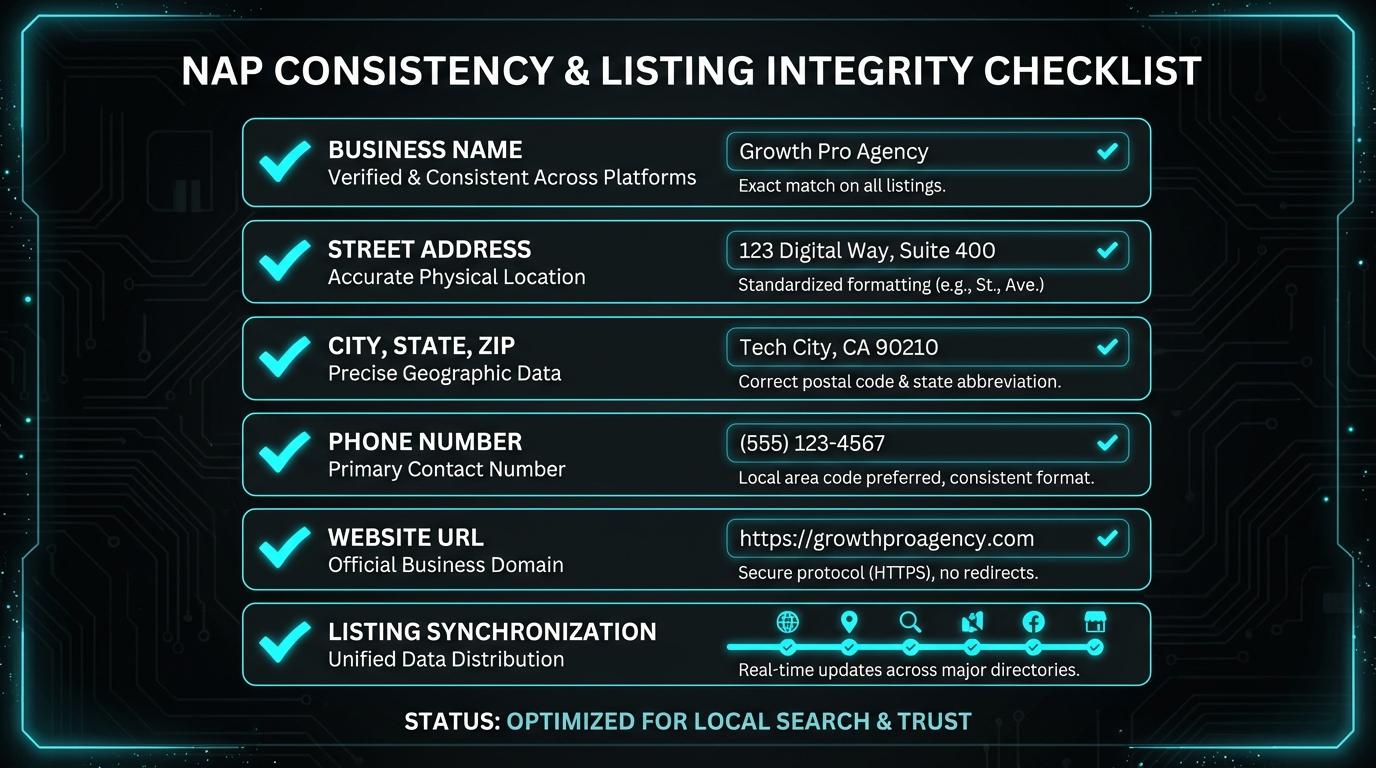
NAP stands for Name, Address, and Phone number. For home service contractors, these three pieces of information act as your business’s unique digital fingerprint. When your NAP data is consistent across the web, it sends a powerful signal to search engines that your business is legitimate, active, and located exactly where you say it is.
In the world of local SEO, this is often expanded to NAP+W, emphasizing the importance of your Website URL as the final piece of the identity puzzle.
- Business Name: Use your exact legal or DBA name as it appears on your service trucks and signage (avoid keyword stuffing here).
- Physical Address: Use a precise address, including suite or unit numbers, matching your Google Business Profile.
- Local Phone Number: Prioritize a local area code over toll-free numbers to reinforce your local presence.
- Website URL: Ensure the link leads to a high-performing landing page or your homepage.
- Business Hours: Sync your hours across all platforms, including special holiday hours.
Common Citation Sources for Contractors
To maintain listing integrity, you must audit your information across the primary directories that Google crawls to verify your data. Key platforms for the home service industry include:
- Yelp
- Angi (formerly Angie’s List)
- HomeAdvisor
- Thumbtack
- Bing Places
- Apple Maps
- The Better Business Bureau (BBB)
The Algorithmic "Penalty" of Inconsistency
While Google rarely issues a manual penalty for mismatched phone numbers, the "penalty" manifests as a significant loss in ranking potential. According to the Moz Local Search Ranking Factors survey, the consistency of structured citations is a foundational signal for the local algorithm.
The logic is simple: Google’s primary goal is to provide users with accurate information. If one directory lists your old office address while your Google Business Profile lists a new one, the algorithm detects a data conflict. This ambiguity creates a lack of "algorithmic trust." When Google cannot verify your location with 100% certainty, it will suppress your listing in favor of a competitor with cleaner, more reliable data. For contractors, this often results in being pushed out of the coveted Google Map Pack.
Maintaining a clean "digital paper trail" is essential for long-term Google Business Profile optimization.
Visual Content Strategy: Showcasing Work and Geo-tagging
High-quality imagery is the most direct way to build trust with potential clients before they ever pick up the phone. For contractors, Google Business Profile optimization requires a consistent stream of visual proof that validates your expertise and proximity to the job site.
To maximize engagement, focus on uploading these high-impact photo types regularly:
- Project Progress: Mid-construction shots that show your team’s technical process and safety standards.
- Finished Work: Wide-angle, well-lit photos of completed projects that highlight the final aesthetic.
- Branded Assets: High-resolution images of your wrapped trucks, equipment, and team members in uniform to verify business legitimacy.
- Detailed Craftsmanship: Close-up shots of intricate work, such as tile patterns, clean electrical wiring, or perfect roof shingle alignment.
The Power of Geo-tagging for Local Relevance
Geo-tagging is the process of embedding GPS coordinates (latitude and longitude) into your image’s metadata. This provides Google with an unverified but strong signal that your business is actively performing work in specific neighborhoods. By consistently uploading geo-tagged images from across your service area, you reinforce your relevance for local searches and improve your chances of appearing in the Google Maps Local Pack.
To execute this technically, contractors can use tools like GeoImgr or Watermarkly. The process is straightforward: upload your project photos to the tool, place a pin on the map where the job was completed (or enter the exact coordinates), and click "Write EXIF Tags." Once you download the updated file, the location data is permanently attached to the image, allowing you to optimize your digital presence more effectively when you upload the file to your profile.
The Effectiveness of Before-and-After Photos
Nothing converts a skeptical lead faster than a clear before-and-after comparison. These photos serve as a "mini-case study" that demonstrates the immediate value of your services. When posting these to your Google Business Profile, ensure both photos are taken from the exact same angle and under similar lighting conditions to provide a professional, honest look at the transformation.
Beyond standard uploads, these comparisons are highly effective when used in Google Business Posts. Adding a brief caption describing the problem (the "before") and your specific solution (the "after") creates a narrative that resonates with homeowners facing similar issues, significantly boosting your local SEO for contractors efforts through increased user interaction.
Maximizing Engagement Through Regular Profile Updates
Many contractors treat their Google Business Profile as a digital business card. They set it up once and assume the job is done. This "set-and-forget" mentality is a myth that costs you leads.
Google prioritizes businesses that are active and engaged. By consistently updating your profile, you signal to search algorithms that your business is operational, relevant, and responsive. This activity directly influences your visibility in the Local Pack.
Google Posts: Frequency and Ranking Impact
Google Posts are essentially free micro-advertisements that appear directly in your search results. Think of them as a social media feed specifically designed for people looking to hire you right now.
For maximum impact, you should aim to publish at least one post per week. This frequency keeps your profile "fresh" in the eyes of Google’s algorithm. It also ensures that potential customers always see current offers or recent project successes when they find you.
Regular posting increases your click-through rate by providing immediate value. Whether it’s a seasonal discount or a look at a finished job site, these updates turn passive searchers into active callers. Consistent activity is a core component of local SEO for contractors and is vital for maintaining a competitive edge.
5 Post Ideas for Your Contractor Profile
To keep your feed engaging, rotate through different types of content. Here are five proven post ideas to boost your Google Business Profile optimization for contractors:
- Project of the Week: Share a high-quality "before and after" photo of a recent job. Briefly describe the problem you solved for the homeowner.
- Seasonal Maintenance Tips: Provide value by telling homeowners how to prepare their property for upcoming weather changes (e.g., "5 Tips to Winterize Your Plumbing").
- FAQ Spotlight: Take a common question you get on-site and answer it in a post. This builds authority and addresses barriers to booking.
- Meet the Team: Introduce a lead technician or office manager. Personalizing your brand builds trust before the first phone call.
- Limited-Time Offers: Create urgency with a "Google-Exclusive" discount for the first five people who book a specific service this month.
By integrating these updates into your weekly routine, you transform your profile from a static listing into a lead-generation engine. This proactive approach is exactly how a top-tier contractor SEO agency ensures long-term dominance in local search results.
Leveraging Reviews and Social Proof for Growth
For contractors, reviews are more than just feedback—they are the digital currency of trust. High-quality, frequent reviews directly correlate with higher visibility in the Local Pack. Beyond basic star counts, the impact of reviews on local SEO ranking factors is a primary driver for how Google validates your business’s authority and reliability.
In the evolving landscape of AI Overviews (AEO), reviews have taken on a new technical significance. Large Language Models (LLMs) like Gemini and ChatGPT function as trust aggregators. When a homeowner asks for the "Best roofing contractor in Dallas," these models scan review text to perform sentiment analysis. They look for specific clusters of positive sentiment and recurring keywords (e.g., "on time," "fair price," "professional cleanup") to serve as a trust signal. If your profile lacks recent, positive sentiment, AI engines are less likely to recommend you as a top-tier option. This makes (https://growthproagency.com/answer-engine-optimization/) heavily dependent on the qualitative data found within your Google Business Profile reviews.
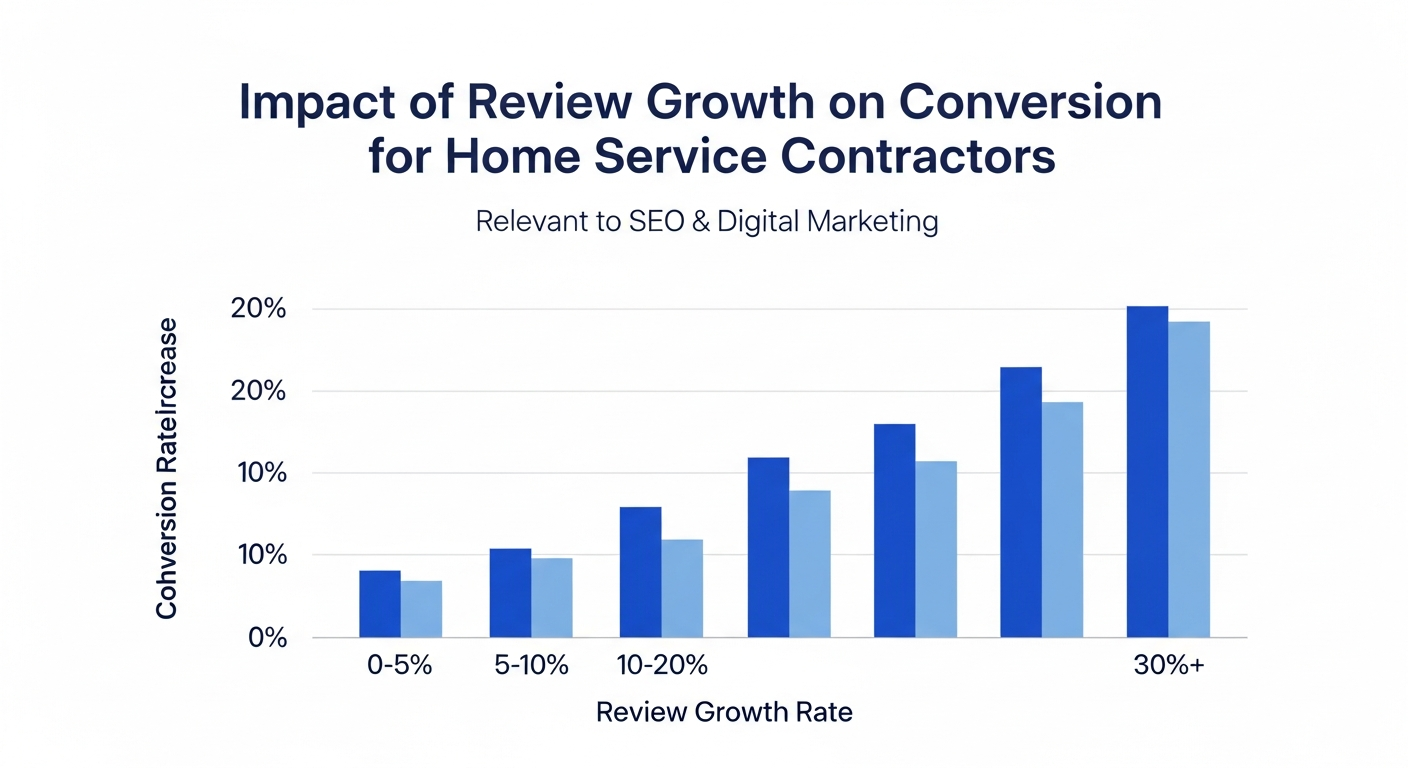
To maintain a competitive edge, contractors should implement a systematic approach to review generation:
- Automated Text Requests: Send an SMS link immediately after a technician marks a job as "complete" in your CRM.
- On-Site QR Codes: Provide technicians with business cards or truck decals featuring a direct QR code to your "Write a Review" page.
- Keyword-Rich Responses: Always respond to reviews. Mention the specific service provided (e.g., "Glad we could help with your emergency pipe repair!") to help LLMs associate your brand with specific service categories.
- Video Testimonials: While not part of the GBP star rating, embedding video social proof on your linked landing pages helps satisfy the "Experience" and "Trust" components of Google’s E-E-A-T guidelines.
Integrating Third-Party Testimonials
While your Google Business Profile is the priority, it should not exist in a vacuum. Integrating third-party social proof from platforms like Angi, Houzz, or Facebook creates a "halo effect" for your online reputation.
Google’s algorithms and (https://growthproagency.com/generative-engine-optimization-contractors/) look for consistency across the web. If your GBP has 100 reviews but your Facebook page is filled with unresolved complaints, it creates a "trust gap" that can suppress your rankings. Ensure your business information is consistent across all review platforms to reinforce the data signals Google uses to rank your contracting business.
Mastering Q&A Management and Customer Messaging
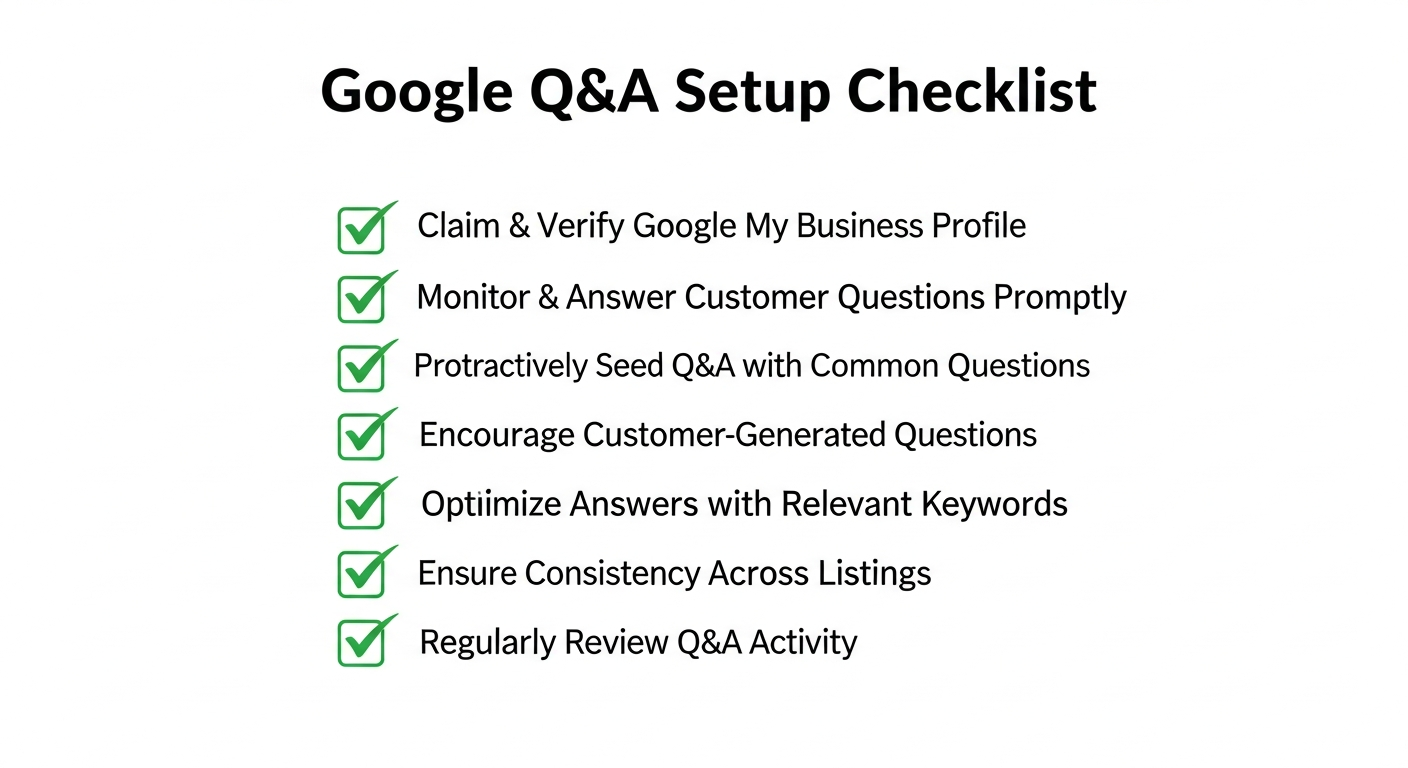
Managing the Questions & Answers and Messaging features of your Google Business Profile (GBP) is no longer optional—it is a critical component of Answer Engine Optimization (AEO). For contractors, these sections act as a live FAQ that can influence a lead’s decision before they even visit your website.
Optimizing Your Q&A for Lead Conversion
The Q&A section is a crowdsourced space, but savvy contractors take control by "seeding" their own questions. You are legally allowed to ask and answer your own questions on your profile. This allows you to address common sales objections and highlight key selling points directly in the search results.
When answering, always use service-specific keywords naturally to help Google understand your expertise. Monitor this section closely, as anyone can answer questions left by customers; ensuring your official response is the first and most accurate is vital for maintaining brand authority.
20 High-Value Q&A Ideas for Contractors
To maximize your profile’s impact, prepopulate your Q&A section with these strategic questions and answers:
- Are you licensed and insured in this state?
Answer: Yes, we are fully licensed, bonded, and insured. We prioritize safety and compliance on every job site.
- Do you offer emergency repair services after hours?
Answer: We offer 24/7 emergency services for to ensure your home stays safe at all hours.
- Do you provide free, no-obligation estimates?
Answer: Absolutely! We provide detailed, free estimates for all major projects. You can request one via the "Quote" button on our profile.
- What financing options do you have available?
Answer: We offer flexible financing plans to fit your budget, including 0% interest options for qualified homeowners.
- Do you handle the building permit process?
Answer: Yes, our team manages the entire permit and inspection process with local municipalities so you don’t have to.
- Are your technicians background-checked?
Answer: For your peace of mind, every member of our team undergoes a rigorous background check and regular safety training.
- What kind of warranty do you offer on your work?
Answer: We stand behind our craftsmanship with a -year labor warranty in addition to manufacturer warranties on materials.
- Do you offer senior or military discounts?
Answer: We are proud to offer discounts to our seniors and active-duty military members. Please mention this during your estimate!
- How soon can you start a new project?
Answer: Our lead times vary by season, but we typically can schedule a consultation within business days.
- What specific brands of materials do you use?
Answer: We use industry-leading brands like and to ensure the highest quality and longevity for your home.
- Do you provide services for commercial properties?
Answer: While we specialize in residential , we do take on select commercial projects. Please contact us for details.
- How do you protect my property during construction?
Answer: We use drop cloths, protective barriers, and perform a thorough daily cleanup to ensure your home remains clean and safe.
- Do you offer virtual consultations?
Answer: Yes, we can provide initial assessments via video call for certain project types to save you time.
- What areas do you serve specifically?
Answer: We serve [City], [City], and the surrounding areas. Check our "Service Area" section for a full list of zip codes.
- Do you offer preventative maintenance plans?
Answer: Yes, we offer annual maintenance packages to keep your in peak condition year-round.
- What forms of payment do you accept?
Answer: We accept all major credit cards, checks, and secure online payments through our client portal.
- Can I see examples of your recent work?
Answer: Certainly! Please visit the "Photos" section of our Google Business Profile or our website’s portfolio page.
- How do you handle project changes or "scope creep"?
Answer: Any changes to the original plan are documented via a formal change order so there are never surprises on your final invoice.
- What is your cleanup process after a job is finished?
Answer: We perform a "white-glove" cleanup, including debris removal and magnetic sweeping for nails/metal, leaving your yard spotless.
- Why should I choose you over a larger national franchise?
Answer: As a local, family-owned business, we provide personalized service, deeper knowledge of local building codes, and direct accountability.
Google Messaging Best Practices
Enabling Google Messaging allows potential clients to text your business directly from the search results. For contractors, speed is the primary ranking factor for conversion here. Google tracks your response time, and if you consistently take longer than 24 hours to reply, they may disable the messaging feature for your profile.
To master messaging, download the Google Maps app and enable push notifications so you never miss a lead. Use "Welcome Messages" to set expectations, such as, "Thanks for reaching out! A member of our team will be with you in 15 minutes." This immediate engagement keeps the homeowner from clicking on the next contractor in the Google Local Pack.
Advanced Signals: Maps Ranking, AI Overviews, and LLM Citations
Maps App vs. The Local Pack: Understanding the Distinction
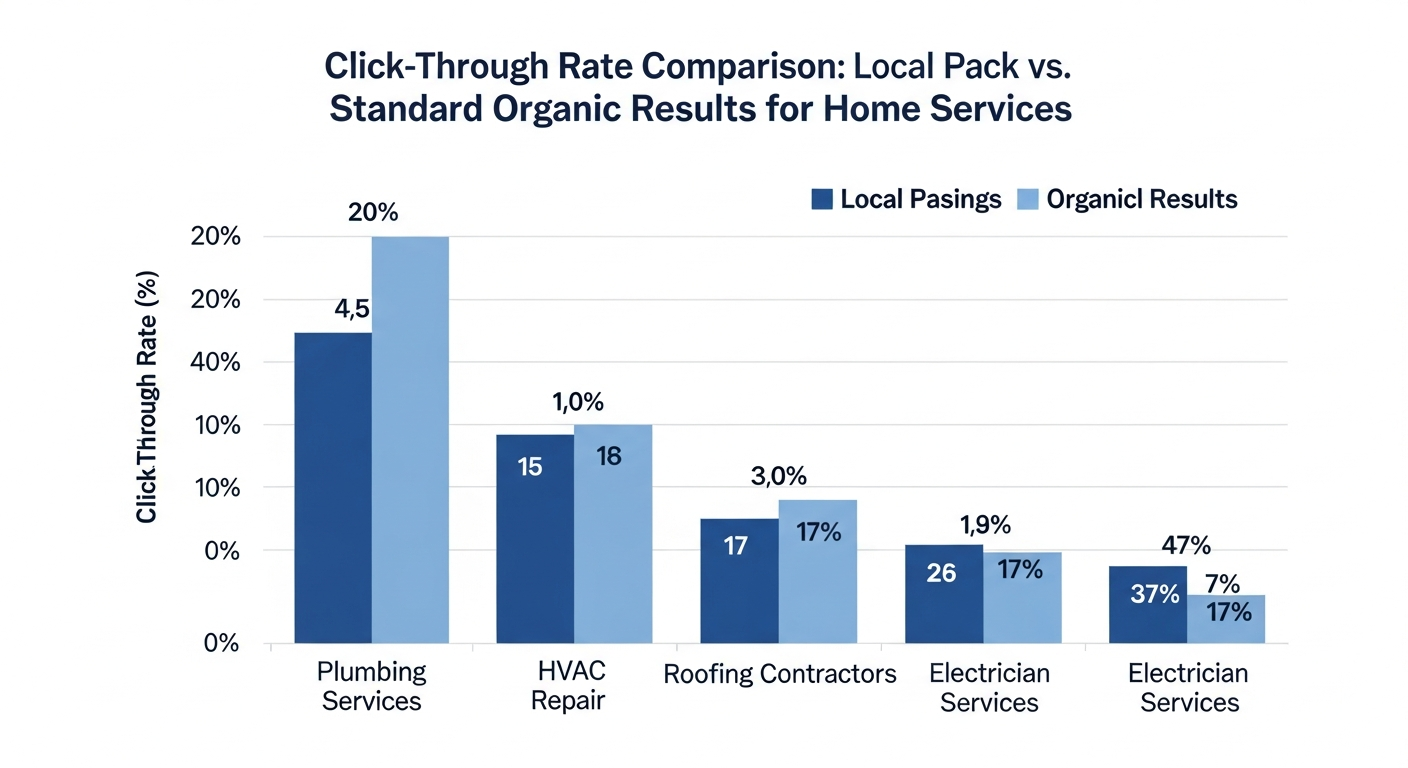
To master Google Business Profile optimization for contractors, you must distinguish between the two primary ways users find your business: the Google Maps App and the Local Pack on the search engine results page (SERP). The Local Pack is the set of three business listings that appear at the top of a standard Google search for terms like "roofing contractor near me." It is designed for quick discovery and comparison. In contrast, the Google Maps App is a dedicated navigational environment where users often exhibit higher intent, frequently searching while mobile or specifically looking for directions. While the Local Pack focuses on immediate visibility among general search results, Google Maps SEO requires a deeper focus on proximity and real-time signals to capture users who are already in the "navigation" phase of their journey.
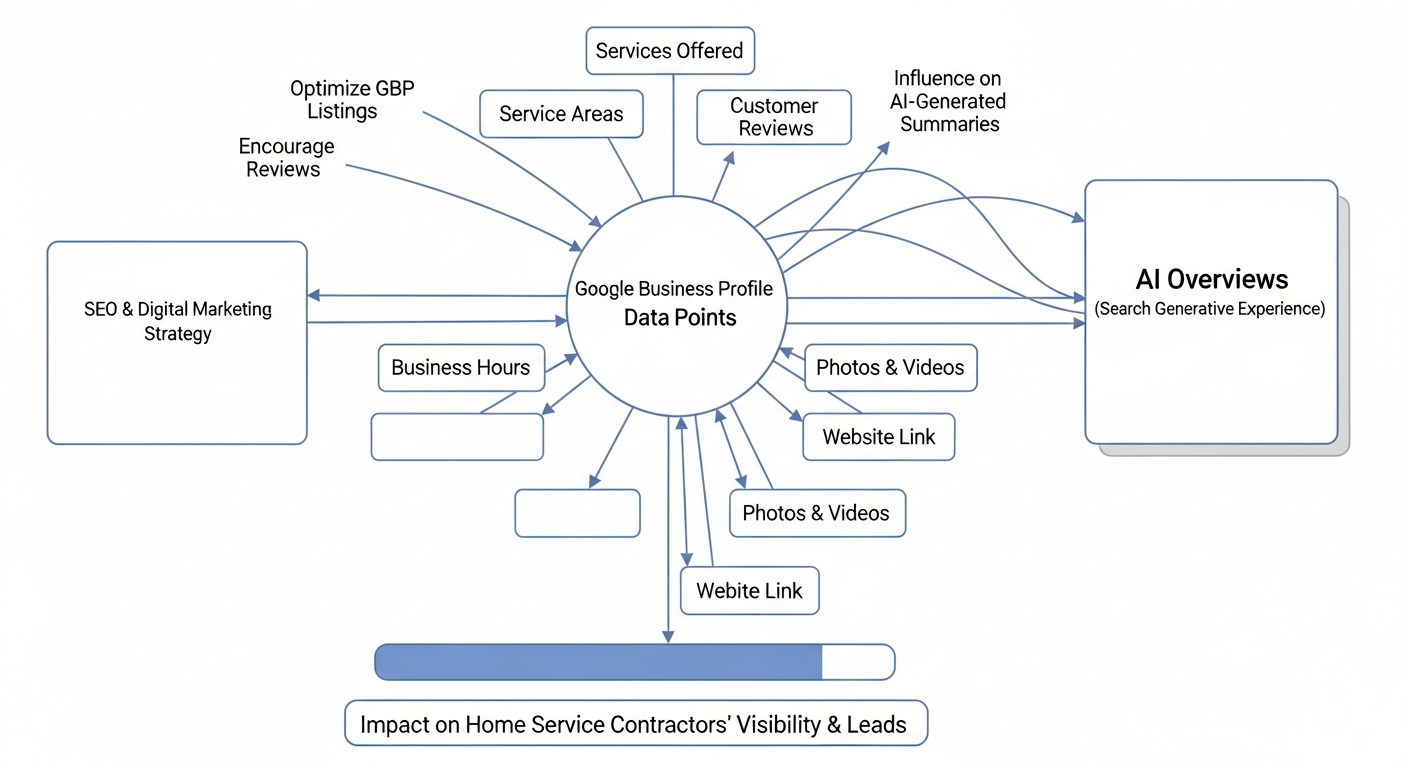
Beyond traditional search, your profile now serves as a foundational data source for AI Overviews (formerly SGE) and Large Language Models (LLMs) like ChatGPT and Gemini. These systems do not just "rank" links; they synthesize information to provide direct answers. When an AI generates a recommendation for a "reliable HVAC contractor in Austin," it pulls from your GBP attributes, service descriptions, and customer sentiment found in reviews. Ensuring your profile is data-rich and contains specific keywords allows these AI engines to cite your business as a trusted authority, bridging the gap between traditional local SEO and Answer Engine Optimization (AEO).
Technical Tracking with GBP Insights
Moving beyond surface-level vanity metrics, advanced contractors must use GBP Insights to analyze the technical health of their local presence. The most critical distinction to monitor is Discovery vs. Branded searches. Discovery searches occur when a user finds your listing while searching for a category or service (e.g., "plumber"), whereas Branded searches happen when a user searches specifically for your company name.
For a growing home service business, a high percentage of Discovery searches is the primary indicator of a successful local SEO strategy, as it proves you are reaching new customers who weren’t already aware of your brand. By monitoring these trends within GBP Insights, you can identify which service areas are underperforming and adjust your primary categories or service descriptions to better align with local search volume.
Connecting Local Visibility to Technical SEO and AEO
For home service contractors, local visibility and site-wide authority are deeply interconnected. The signals generated by your Google Business Profile—such as proximity, review velocity, and business categories—serve as a foundation for how search engines perceive your overall entity. When these local signals are synchronized with your website’s technical infrastructure, it creates a powerful synergy that elevates your rankings across both the Map Pack and organic search results.
The intersection of local and technical optimization typically focuses on three core areas:
- LocalBusiness Schema: Implementing advanced JSON-LD markup on your website that mirrors your GBP data to eliminate entity confusion and reinforce your service area.
- Geographic Content Alignment: Building localized landing pages that provide deep context for the specific neighborhoods and cities listed in your Google Business Profile.
- Knowledge Graph Integration: Maintaining strict NAP consistency (Name, Address, Phone) across the web to help search engines accurately categorize your business within their global knowledge graph.
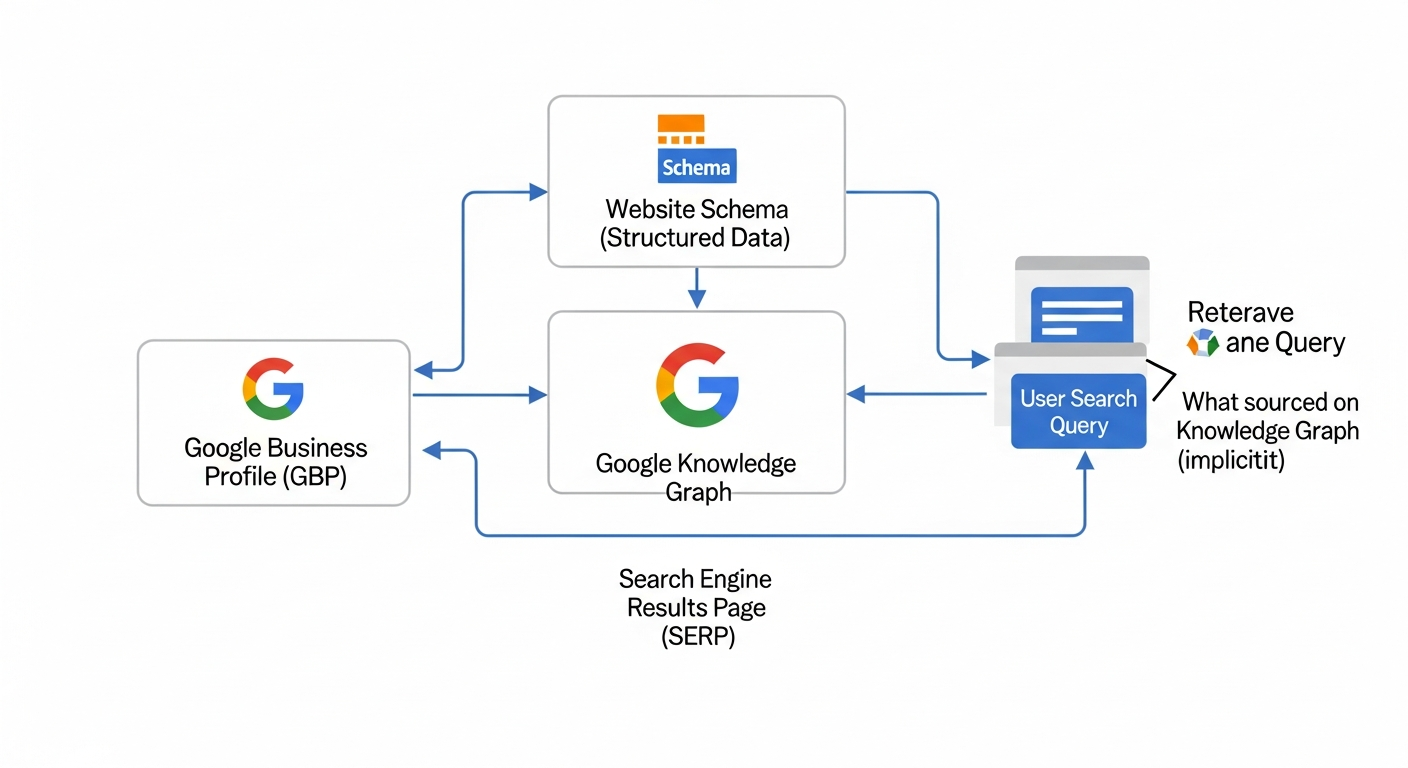
As the search landscape evolves toward Search Generative Experience (SGE) and AI-driven discovery, the data from your local profile is becoming a primary source for conversational answers. In this new era, search engines don’t just provide a list of links; they synthesize information to recommend the most trustworthy provider. To maintain a competitive edge, it is vital to bridge the gap between map rankings and advanced technical SEO and AEO strategies to ensure your business is cited as the definitive authority by Large Language Models (LLMs) and AI search agents.
Frequently Asked Questions About Contractor GBP Optimization
How long does it take for GBP optimizations to impact my local ranking?
Local ranking improvements typically become visible within two to four weeks after making significant updates. While some changes like category adjustments can reflect in days, the full impact on the local pack depends on how quickly Google recrawls your business information and evaluates it against competitors. In highly saturated markets, it may take several months of consistent posting and review generation to see a definitive shift in position.
Can I hide my physical address if I work from home as a contractor?
You can absolutely hide your physical address by configuring your profile as a Service Area Business. During the setup process, you should clear the address field and instead define the specific cities, counties, or zip codes where you provide on site services. This keeps your home address private while still allowing your business to appear for searches within your designated service radius.
What should I do if a competitor has a duplicate listing or is using a fake address?
When you identify a competitor using a fake address or maintaining duplicate listings, you should use the Suggest an edit tool directly on Google Maps to report the violation. If the issue persists and negatively impacts your rankings, submitting a formal Business Redressal Complaint is the necessary next step. Google reviews these reports to maintain map accuracy and will remove profiles that violate their representation guidelines.
Does Google Messaging affect my profile’s responsiveness score?
Google tracks your response time and frequency when messaging is enabled, though it does not publicly display a numerical score. Maintaining a high responsiveness rate by replying within 24 hours is essential for keeping the feature active on your profile. Quick replies signal to the algorithm that your business is active and reliable, which improves the overall user experience and conversion potential.
How do I track if my GBP is appearing in AI Overviews or LLM citations?
Tracking AI visibility requires monitoring the Performance tab in your profile manager for specific long tail queries that trigger generative answers. While Google does not yet provide a dedicated AI Overview metric, you can identify these wins by looking for an increase in Discovery searches and mentions in Search Console for complex, natural language questions. Using a well structured profile ensures your business data is ready for the technical requirements of modern discovery engines.
Dominate Your Local Market Today
Scaling your home service business requires more than just a basic profile. To stay ahead of the curve, download our Contractor GBP Domination Checklist and learn how to integrate these local signals with advanced technical SEO and AEO strategies that capture high value leads from every corner of the digital landscape.