AEO vs SEO: Key Differences and Why You Need Both in 2026
The digital landscape is rapidly shifting as Large Language Models transform how users seek information, moving focus away from traditional blue links toward direct, synthesized answers. You need a cohesive approach that secures visibility both in established Search Engine Optimization (SEO) rankings and the emerging domain of Answer Engine Optimization (AEO).
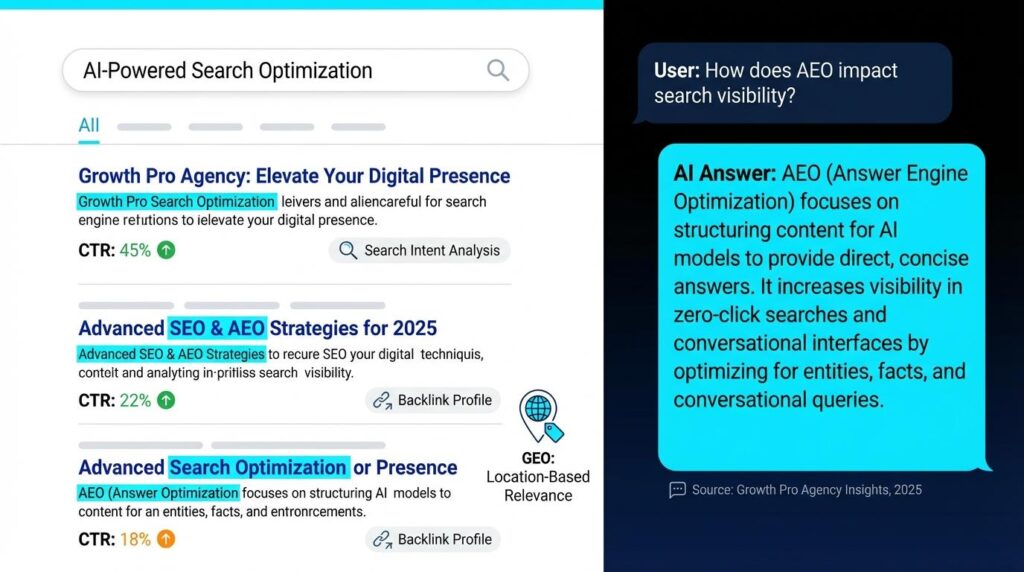
This guide defines traditional SEO’s focus on keyword placement and click-through rates, contrasting it with AEO’s mandate to become the definitive source cited within conversational AI interfaces. You will see how these strategies differ in execution, specifically regarding content structure and measurement, and understand why AEO is not a replacement for, but an evolution of, sound search practice. For example, while traditional SEO targets high click-through rates (CTR), AEO success is increasingly measured by citation frequency within AI overviews. Mastering this duality, alongside Generative Engine Optimization (GEO), is essential for maintaining complete digital authority in 2025 and beyond.
What Is SEO? (Traditional Search Engine Optimization)
SEO is the process of improving your website’s visibility in search engine results. For home service businesses, it means appearing at the top when potential customers search for terms like “plumber near me” or “emergency roofing repairs.”
The primary goal of SEO for home services is to earn unpaid (organic) traffic. By proving to search engines like Google that your content is the most relevant answer to a user’s query, you secure a prominent spot on the first page.
The Mechanics of Ranking and Clicks
Traditional SEO relies on a cycle of crawling, indexing, and ranking. Search engines send “bots” to read your site, store that data in a massive digital library, and then rank your pages based on factors like site speed, mobile-friendliness, and local relevance.
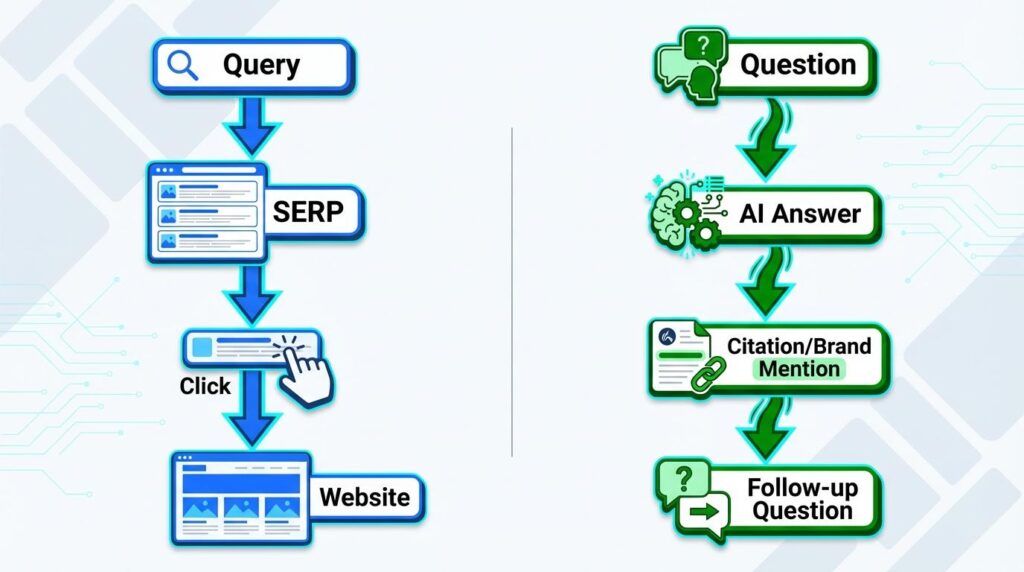
In this model, the ultimate objective is the click. You want users to see your link on a Search Engine Results Page (SERP) and click through to your website to book a service or request a quote.
[insert flowchart showing the process from user search to website visit]
Effective contractor SEO services focus on optimizing your site structure and content to satisfy these search engine algorithms. This ensures your business remains visible to customers at the exact moment they need your professional expertise.
Key Performance Indicators for SEO
To measure the success of a traditional strategy, home service providers typically track how users interact with their listings and website. These metrics help determine if your local SEO for contractors is delivering a return on investment:
- Organic Traffic: The total number of visitors who find your website through non-paid search results.
- Click-Through Rate (CTR): The percentage of people who see your link in search results and actually click on it.
- Bounce Rate: The percentage of visitors who leave your site after viewing only one page, which indicates whether your content met their immediate needs.
By focusing on these KPIs, you can refine your online presence to attract more high-quality leads. While SEO remains a cornerstone of digital marketing, the rise of AI is introducing a new evolution to this traditional model: AEO.
What Is AEO? (Answer Engine Optimization)
Answer Engine Optimization (AEO) is the process of optimizing your online presence to be the primary source for AI-driven responses. While traditional SEO focuses on ranking your website in a list of search results, AEO focuses on being the definitive answer provided by Large Language Models (LLMs) and AI search assistants.
As AI becomes the first point of contact for consumers, Search Engine Land on AEO trends suggests that visibility is no longer just about blue links; it is about becoming part of the AI’s internal knowledge base. For home service contractors, this means that instead of just appearing for “plumber near me,” your business needs to be the one ChatGPT, Gemini, or Perplexity recommends when a user asks, “Who is the most reliable emergency plumber available right now in Phoenix?”
Direct Citations and AI Overviews
The fundamental difference between AEO and traditional search lies in how information is gathered. Traditional SEO relies on crawling, where bots scan pages to index keywords. AEO, however, focuses on LLM ingestion.
In this new paradigm, AI models do not just “find” your page; they ingest your data to understand the semantic meaning of your services. When a user queries an AI, the model synthesizes an answer based on its training data and real-time “web browsing” capabilities. To win in AEO, your content must be structured so that these models can easily cite your business as a trusted authority. Understanding The Future of AI in Digital Marketing is essential for contractors who want to stay ahead of this technical shift from indexing to ingestion.
The Shift from Keywords to Intent
AEO requires a departure from rigid keyword stuffing. Instead, it prioritizes conversational intent. The shift is characterized by:
- From Strings to Sentences: Users no longer type “AC repair.” They ask, “Why is my AC blowing warm air and how much will it cost to fix?”
- From Discovery to Synthesis: AI doesn’t give users a list of sites to visit; it provides a synthesized summary of the “best” options.
- From Traffic to Authority: Success isn’t measured by clicks to a homepage, but by the frequency with which an AI cites your brand as the expert solution.
- From Broad to Hyper-Local Context: AEO leverages the specific data points of your business—like reviews and service areas—to answer highly specific, intent-driven questions.
Visualizing the Journey (Diagram Placement)
The transition from traditional search to AI-driven answers represents a fundamental change in how your customers find you.
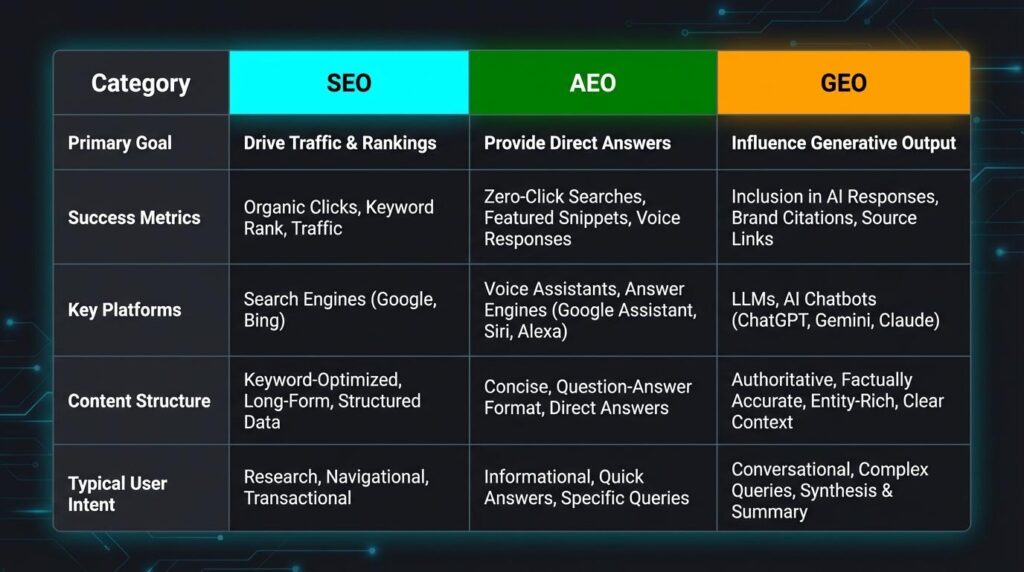
Comparison TCable: SEO vs. AEO vs. GEO
Understanding where your marketing efforts fall is critical for resource allocation. The following table breaks down the core differences between traditional search, answer engines, and the emerging field of Generative Engine Optimization (GEO).
| Feature | SEO (Search Engine Optimization) | AEO (Answer Engine Optimization) | GEO (Generative Engine Optimization) |
| :— | :— | :— | :— |
| Primary Goal | Driving organic traffic to a website. | Providing direct answers to user queries. | Being cited by LLMs (Large Language Models). |
| Success Metrics | Clicks, CTR, Rankings (1-10). | Zero-click results, Voice citations. | Citations in AI Overviews, Brand mentions. |
| Key Platforms | Google, Bing, Yahoo. | Alexa, Siri, Google Assistant, Perplexity. | ChatGPT, Google Gemini, Claude. |
| Content Focus | Keywords and Page Authority. | FAQs, Schema, and Snippets. | Narrative context and factual authority. |
Content Structure and Schema Requirements
To win in the AEO landscape, your website’s technical foundation must be more rigid than traditional SEO requires. While a blog post might rank in Google based on good keyword density and backlinks, an Answer Engine needs structured data to understand the relationship between your services and the user’s problem.
For contractors, this means implementing advanced Schema Markup. Without specific “Service,” “LocalBusiness,” and “FAQ” schema, AI models may struggle to verify your service area or pricing. If you are looking to strengthen your foundational presence, our comprehensive local SEO for contractors guide provides a step-by-step breakdown of how to align your site for both humans and bots.
Long-tail Queries and Conversational Search
The way users search has evolved from “shorthand” to “conversational.”
- SEO Keyword: “Roofing contractor Atlanta”
- AEO Query: “Which roofing contractor in Atlanta offers the best warranty on metal roofs?”
AEO focuses heavily on long-tail queries. Because Answer Engines are often triggered by voice or chat, the queries are longer, more specific, and framed as questions. To execute this effectively, your content must mirror the natural language of your customers. Instead of just listing “Emergency Plumbing,” you should create content that directly answers, “What should I do if my water heater leaks in the middle of the night?”
By positioning your brand as the immediate solution to these specific conversational questions, you increase the likelihood of becoming the “Chosen Answer” in the AI-driven search era.
[insert screenshot example of a Perplexity answer vs. a Google Search result here]
Will AEO Replace SEO in the Near Future?
The rise of generative AI has sparked a familiar headline in the digital marketing world: “SEO is dead.” With AI engines providing direct answers to user queries, many home service business owners fear that traditional search engine optimization will become obsolete. However, the reality isn’t a replacement; it is an evolution.
While Answer Engine Optimization (AEO) is changing how users interact with information, it relies on the same digital signals that have powered SEO for decades. Instead of one replacing the other, we are entering an era where AEO and SEO work in tandem to capture different stages of the customer journey.
The Coexistence of Direct Answers and Deep Research
The primary shift in search behavior is the distinction between zero-click snippets and deep research queries.
- Zero-Click Snippets (AEO Territory): These are quick, informational queries like “What is the standard SEER rating for HVAC?” AI engines pull a direct answer, often satisfying the user without them ever clicking a link. While this may seem like a loss for traffic, appearing as the source in these snapshots builds massive brand trust.
- Deep Research Queries (SEO Territory): When a homeowner needs a high-ticket service—such as a full roof replacement or a complex electrical overhaul—they rarely rely on a 50-word AI summary. They perform deep research, comparing local SEO services, reading reviews, and examining project portfolios.
According to Google’s documentation on AI Overviews, search engines still aim to connect users with the best information on the web. AI is simply a new interface for the same high-quality data that SEO has always sought to organize.
Why SEO Remains the Foundation
AEO cannot exist in a vacuum. AI models and Large Language Models (LLMs) are “trained” on the open web. If you stop performing SEO, your “data footprint” shrinks, making it impossible for AI engines to find, trust, or cite your business.
To stay relevant in both traditional search and AI-driven answers, you must maintain the core pillars of SEO. These elements provide the authority and context that AI engines require:
- Domain Authority: AI engines prioritize sources that are recognized as experts in their niche.
- Backlink Profile: Links from reputable local sites act as “votes of confidence” for LLMs.
- Technical Site Architecture: Clean code and fast load times ensure crawlers can easily digest your content for AI training.
- E-E-A-T (Experience, Expertise, Authoritativeness, Trustworthiness): Proving you are a real, licensed contractor through structured data and verified reviews is essential for ranking in AI results.
For home service providers, the goal isn’t to choose between aeo vs seo. It’s about building a robust digital presence where your plumbing SEO or HVAC content feeds the very answers that AI engines provide to your future customers.
SEO vs AEO vs GEO: The New Triple Threat of Visibility
In the current digital landscape, visibility is no longer a single-front battle. For years, SEO (Search Engine Optimization) was the only game in town. Then came AEO (Answer Engine Optimization), prioritizing direct responses for voice and AI assistants. Now, we have entered the era of GEO (Generative Engine Optimization).
For service-based businesses like HVAC companies or Law Firms, these three pillars represent a “triple threat.” Mastering all three provides a massive competitive advantage: you don’t just appear in search results; you become the definitive answer and the AI’s top recommendation.
Defining GEO for Local Businesses
Generative Engine Optimization (GEO) is the newest and perhaps most critical frontier for local visibility. While SEO focuses on ranking in “Blue Links” and AEO focuses on providing a single direct answer, GEO is about influencing how Large Language Models (LLMs) like ChatGPT, Claude, and Google Gemini perceive and cite your business.
When a potential client asks ChatGPT, “Who is the most reliable HVAC contractor for emergency repairs in St. Louis?” or asks Gemini, “What are the top-rated personal injury lawyers near me?”, the AI doesn’t just list websites. It synthesizes data to provide a curated recommendation.
To win in GEO, service businesses must focus on:
- Citations and Mentions: Being cited across authoritative local directories and news sites.
- Brand Sentiment: Ensuring reviews and social mentions reflect high trust and expertise.
- Technical Entity Clarity: Using advanced schema so AI “understands” your service area and specialties.
Implementing an Advanced Local SEO Strategy for Service Businesses is the first step toward feeding these generative engines the structured data they crave.
Integrating the Three Pillars (The Triple Threat Strategy)
Balancing SEO, AEO, and GEO requires a cohesive approach. You cannot ignore one without weakening the others. Use the following step-by-step process to ensure your business dominates across all platforms:
- Build a Strong SEO Foundation: Ensure your website is technically sound, mobile-responsive, and fast. Search engines still provide the underlying data that AI models use to learn about your business.
- Optimize for AEO with FAQ Content: Create dedicated sections that answer specific, long-tail questions. Frame your content in a “Question-Answer” format to capture featured snippets and voice search results.
- Prioritize Google Business Profile Optimization: For local service businesses, your GBP is the most influential “entity” record. Consistent Google Business Profile Optimization ensures that Google’s generative AI (SGE/Gemini) views your business as a verified, high-authority local leader.
- Cultivate Third-Party Authority (GEO): Generative engines look for consensus. Secure placements in local “Top 10” lists, industry associations, and local chamber of commerce sites to build the “digital proof” AI models require to recommend you.
- Monitor AI Citations: Periodically “search” for your services within LLMs to see if your business is being mentioned. If not, analyze the businesses that are being cited and identify the gaps in your digital footprint.
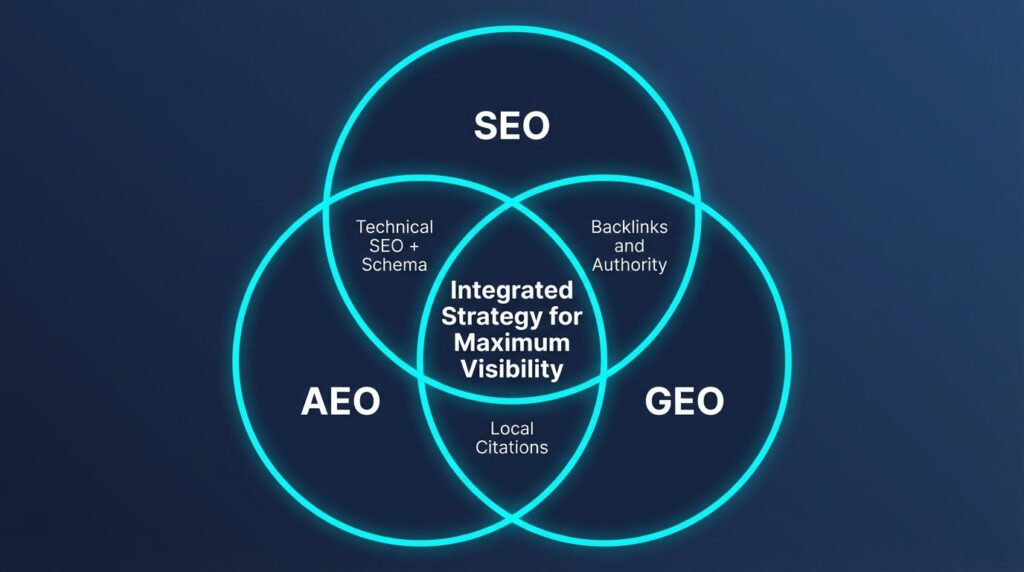
By treating these three disciplines as a unified strategy, an HVAC contractor or Law Firm can move beyond simple rankings and achieve “omnipresence”—ensuring that no matter how a customer searches, your business is the one they find.
How to Measure Success in an AEO-Driven World
In the traditional SEO landscape, success is often binary: you either rank on Page 1 or you don’t. However, as search evolves toward Answer Engine Optimization (AEO), the metrics for success are shifting from “Position 1” to “Citation Frequency” and “Share of Voice.”
Measuring AEO is currently more nuanced because LLMs (Large Language Models) do not always provide a direct click-through rate (CTR) to your website. Instead, the goal is to become the authoritative source that the AI chooses to summarize for the user.
Tracking Brand Citations in AI Responses
The most critical metric in an AEO-driven world is how often an AI model mentions or cites your brand as a source of truth. Unlike traditional backlinks, which are often buried in a list of results, AI citations serve as a direct endorsement within a conversational response.
To track your brand’s presence, you must move beyond standard ranking trackers and adopt a manual or specialized auditing process:
- Manual LLM Auditing: Test a series of “money questions” related to your industry (e.g., “Who is the best HVAC contractor in Orlando?”) across ChatGPT, Gemini, and Perplexity. Document which brands are cited and whether your business is included in the summary.
- Citation Frequency Analysis: Calculate the percentage of times your brand appears across a set of 50–100 core industry prompts. If you are cited in 30 out of 100 prompts, your AEO Share of Voice is 30%.
- Source Verification: Tools like Perplexity often display a list of “Sources” at the top of an answer. Marketers should monitor these specific links to see if their content is being used to build the AI’s final response.
Monitoring Impressions in AI Overviews
Google’s AI Overviews (formerly SGE) represent a hybrid between traditional search and generative AI. While these overviews can reduce clicks to a website, they dramatically increase brand visibility for high-intent queries.
To measure success here, marketers should focus on:
- Google Search Console (GSC) Visibility: Monitor “Impressions” for queries that trigger AI Overviews. Even if clicks are lower, a high impression count in these sections indicates that Google views your site as a top-tier authority.
- Entity Sentiment: Use LLMs to analyze the sentiment of the answers they provide about your brand. Ask the engine, “What is the reputation of [Your Business Name]?” If the AI summarizes your positive reviews and service history accurately, your AEO strategy is succeeding.
- The “Follow-Up” Presence: In conversational search, users often ask follow-up questions. A successful AEO strategy ensures your brand remains part of the conversation as the user digs deeper into a topic.
[insert screenshot or placeholder of an AI Overview citation example here]
By focusing on citation frequency rather than just raw traffic, home service providers and contractors can ensure they aren’t just ranking in a list—they are being recommended by the very AI engines their customers trust for quick answers.
To learn more about how this differs from traditional tactics, check out our guide on AEO vs SEO.
The Role of Technical Architecture in Modern Search Visibility
While SEO has traditionally focused on how humans navigate a site, AEO focuses on how Large Language Models (LLMs) and AI crawlers digest information. To win in both arenas, your website must serve as a reliable, structured data source. The technical foundation you build today determines whether an AI “trusts” your site enough to cite it as a definitive answer.
Machine-Readable Content and Schema Markup
The bridge between traditional SEO and modern AEO is Machine-Readable Content. This refers to data that is formatted specifically for AI algorithms to identify, categorize, and process without the ambiguity of natural language.
The most critical tool for achieving this is Schema Markup (Structured Data). By labeling your content with specific tags, you tell search engines exactly what a piece of information represents—whether it’s a service price, a customer review, or a service area. For home service businesses, this is the “top requirement” for AEO success because it eliminates guesswork for AI agents.
To get started with implementing these technical tags on your own site, refer to our comprehensive Schema Markup Guide for Contractors.
Site Speed and Crawl Efficiency for Rapid AI Updates
AI models and “Answer Engines” like Perplexity or Google’s SGE (Search Generative Experience) prioritize data that is fresh and easily accessible. If your site is slow or difficult to crawl, AI agents may bypass your content in favor of a more efficient source.
To ensure your site remains a high-priority target for AI crawlers, you must optimize the following technical requirements:
- Core Web Vitals: High scores in Largest Contentful Paint (LCP) and Cumulative Layout Shift (CLS) signal a high-quality user experience, which AI models use as a proxy for reliability.
- Crawl Efficiency: A clean XML Sitemap and an optimized robots.txt file ensure that AI bots can find your most important pages without wasting “crawl budget” on low-value URLs.
- Mobile-First Responsiveness: Since a vast majority of AI-driven voice searches occur on mobile devices, your site must be fully optimized for small screens.
- Secure Protocol (HTTPS): Security is a non-negotiable trust signal for both Google’s ranking algorithm and AI recommendation engines.
Why Site Structure is the Bedrock for Answer Engines
Site structure is directly linked to AI reliability. When your website follows a logical, hierarchical architecture (e.g., Home > Services > Specific Service > Location), it creates a “knowledge graph” that AI can easily map.
If your site structure is messy or disorganized, an AI might struggle to verify the relationship between your business and the services you provide. A clean architecture allows AI agents to “triangulate” your data points, increasing the confidence score of the answers they generate for users. By maintaining a clear technical hierarchy, you aren’t just helping a user find a page; you are providing the contextual roadmap that AI needs to recommend your business with certainty.
AEO and SEO Frequently Asked Questions
What is the full form of AEO in marketing?
AEO stands for Answer Engine Optimization. It is the practice of refining digital content to ensure it is selected as the definitive response provided by AI-driven search tools and large language models.
Do I need to implement both SEO and AEO strategies?
Combining these approaches is essential for modern visibility. Traditional SEO drives organic traffic to your website through ranking on results pages, while AEO positions your brand as a trusted source for direct answers in AI snapshots. Neglecting one could mean losing users who prefer conversational queries over traditional keyword searches.
How does content optimization differ between AEO and SEO?
SEO focuses on keyword density, user experience, and link authority to rank a full page for various queries. AEO requires a more granular approach, structuring content into concise, factual segments and using schema markup to help AI scrapers easily digest and cite specific information as a direct answer.
What is GEO in the context of digital marketing?
Generative Engine Optimization (GEO) is a specialized strategy focused on influencing the outputs of generative AI models. It goes beyond simple ranking by ensuring that when an AI generates a response, your brand is not only mentioned but cited as a reliable authority within the generated text.
Which AI platforms does AEO target?
This strategy optimizes content for a variety of conversational platforms and AI-enhanced search engines. Major targets include ChatGPT, Google Gemini, Microsoft Copilot, and Perplexity AI, all of which rely on high-quality, structured data to provide users with immediate answers.
Adapting to these shifting digital landscapes requires a balance between technical precision and strategic content placement to maintain a competitive edge.
Maximize Your Visibility Across Every Engine
Ready to dominate both search results and AI answers? Contact our team today for a comprehensive AEO and SEO audit specifically designed for your service business to ensure you capture every lead in the evolving digital marketplace.