
The Ultimate Guide to Answer Engine Optimization (AEO) for Home Services
The digital landscape for home services is rapidly shifting as users increasingly turn to generative tools like ChatGPT, Gemini, and Google’s AI Overviews for immediate, direct answers rather than traditional links. This page is your complete guide to Answer Engine Optimization, or AEO, the essential discipline for maintaining visibility when search engines prioritize summarized responses.
You will learn how AEO demands a different approach than classic search engine optimization, focusing on structure, conversational clarity, and deep topical authority. We examine the critical difference between traditional link counting and the new emphasis on the 3 C’s: Content, Code, and Credibility, and explore how technical elements like Schema markup provide the necessary language for AI models to trust and cite your expertise. Furthermore, understanding the optimal answer length—for instance, the findings from a SE Ranking analysis showing that answers under 29 words receive the highest citation rate—is key to securing those valuable direct placements.
Mastering these foundational shifts today ensures your service business remains the trusted source that AI directs customers toward tomorrow.
What is Answer Engine Optimization (AEO) and Why Does It Matter Now?
Answer Engine Optimization (AEO) is the strategic process of optimizing your digital presence to ensure your business is the primary source of information for AI-driven “answer engines.” While traditional SEO focuses on ranking within a list of blue links, AEO aims to be the single, definitive answer delivered by platforms like ChatGPT, Perplexity, Gemini, and Google’s AI Overviews (SGE).
For the modern home service provider, this shift represents the next frontier of digital marketing. It is no longer enough to just “be on page one”; you must be the specific solution the AI recommends when a homeowner asks a complex question.
Defining AEO for the Modern Contractor
To a plumber, HVAC technician, or roofer, AEO is the bridge between a potential customer having a problem and choosing your company as the solution. Traditional search engines act as a library where the user looks for a book; answer engines act as a personal consultant who reads the books for the user and summarizes the best advice.
AEO focuses on structured data, conversational clarity, and authority. It requires a departure from keyword stuffing in favor of providing direct, high-value answers to the specific queries your customers are voicing into their phones or typing into AI chatbots.
The Shift from Search to Answers
The way consumers find contractors is fundamentally changing. Instead of browsing multiple websites to compare services, homeowners are increasingly using AI to synthesize information. They are asking, “Who is the most reliable emergency electrician in Atlanta?” or “What are the pros and cons of tankless water heaters for a four-bedroom home?”
When these queries occur, the AI pulls from the most authoritative and well-structured sources available. If your content isn’t optimized for these engines, you risk becoming invisible. This transition is why a modern Home Service SEO Strategy must now integrate AEO principles to remain effective. Without this adaptation, even the most established SEO for home services campaigns will see a diminishing return as user behavior migrates away from traditional results pages.
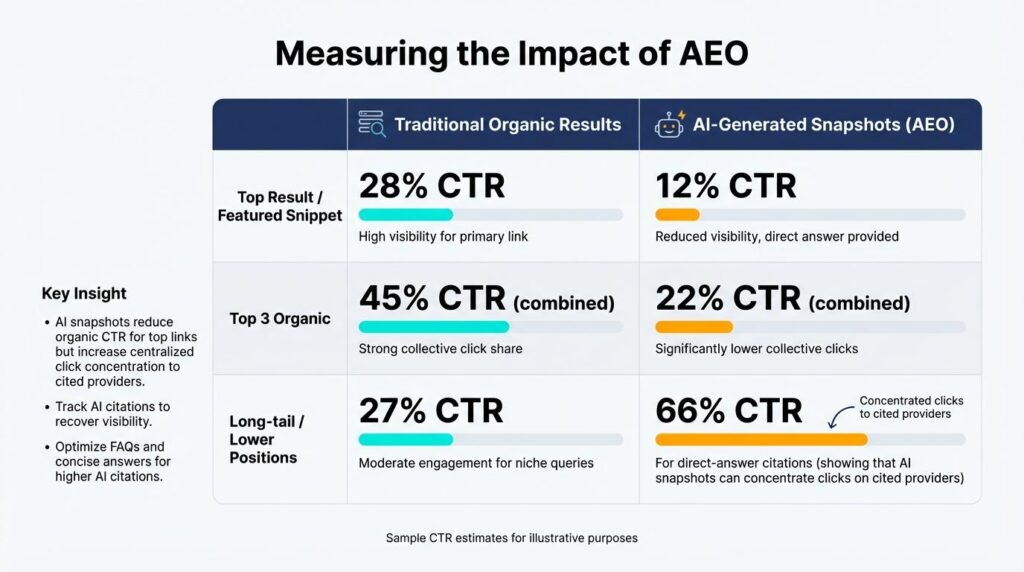
Industry Impact: Is the Threat Overblown?
Some skeptics argue that AI is a passing trend, but the financial and behavioral data suggest otherwise. The impact of AI on information-heavy industries has been immediate and, in some cases, severe. For example, some companies in the education and information sectors saw their market value declined following AI updates as users shifted their habits toward instant AI-generated responses.
For contractors, the threat is not that people will stop needing home repairs, but that the path to discovery is being rerouted. If an AI engine provides a recommendation and a “Click to Call” button before the user ever sees a list of local search results, the businesses optimized for AEO will capture the lead.
Is the threat overblown? No. But for those who pivot early, the threat is actually an unprecedented opportunity to capture market share while competitors are still playing by the old rules of the 2010s.
How AEO Differs from Traditional SEO
While traditional SEO focuses on getting a website to rank in a list of links, Answer Engine Optimization (AEO) is designed to provide a specific, synthesized answer directly to the user. Understanding these differences is critical for any home service business looking to dominate the modern search landscape.
Comparing Strategy and Intent
Traditional SEO is largely about keyword density, backlink profiles, and site structure to please a search engine’s crawler. The goal is to drive a user to click a link and visit a webpage.
In contrast, AEO shifts the focus toward semantic relevance and direct problem-solving. It prioritizes the “Answer” over the “Page.” Because AI models like ChatGPT and Claude search for the most authoritative and concise response to a specific query, your content must be structured to be easily “ingested” by these models.
For example, a traditional SEO strategy might target the keyword “plumber in St. Louis.” An AEO strategy targets the intent behind “Who is the best-rated plumber in St. Louis for an emergency pipe leak?” The latter requires a more sophisticated approach to SGE integration and structured data to ensure your business is the one the AI recommends.
The 3 C’s of SEO in an AI Era
To succeed in the age of answer engines, you must transition from broad content to high-authority, specific data. We categorize this shift using the 3 C’s:
Context: AI models don’t just look for words; they look for meaning. You must provide context by using Schema markup (JSON-LD) to define exactly what your services are and where you provide them.
Conciseness: Answer engines prefer directness. If a user asks “how much does a new HVAC cost,” the AI looks for a clear range or a structured list, not a 2,000-word history of air conditioning.
Credibility: This is the most vital pillar. AI models prioritize E-E-A-T (Experience, Expertise, Authoritativeness, and Trustworthiness). This includes having verifiable reviews, citations on high-authority local directories, and mentions in reputable industry publications.
Will AEO Negatively Impact Your Rankings?
A common concern among contractors is whether the rise of AI snapshots—which often provide the answer without a click—will destroy their organic traffic. The reality is more nuanced: while “top of funnel” informational traffic (like “how to fix a leaky faucet”) may see a drop in click-through rates, the traffic that does reach your site is often much higher in intent.
The following table highlights how click-through rates (CTR) are shifting as AI-generated snapshots become more prevalent:
| Search Result Type | Avg. CTR (No AI Overview) | Avg. CTR (With AI Snapshot) | Estimated Impact |
| :— | :— | :— | :— |
| Organic Position #1 | 39.8% | 12.4% | -68.8% |
| Organic Position #2 | 18.7% | 6.2% | -66.8% |
| Informational Queries | 2.8% | 0.64% | -77.1% |
| Local Pack (Maps) | 14.2% | 11.5% | -19.0% |
By optimizing for AEO, you aren’t just trying to “keep” your old traffic; you are positioning your business to be the preferred recommendation in a zero-click environment. While the total number of clicks might decrease, the quality of leads coming through voice search and AI assistants is significantly higher, as these users are often ready to book a service immediately.
How to Optimize Content for AI-Generated Answers
To secure a spot in an AI Overview or a Perplexity citation, your content must be structured for machine consumption. Unlike traditional SEO, which often rewards long-form depth, Answer Engine Optimization (AEO) prioritizes the immediate accessibility of facts. If an LLM cannot parse your data in milliseconds, it will move on to a competitor’s site.
Formatting for AI Readability
AI models prefer content that is logically organized and semantically clear. To move away from dense blocks of text and improve your chances of being cited, implement the following structural elements:
Use Descriptive Subheadings: Break your content into logical segments using H2 and H3 tags that mirror the user’s intent (e.g., “How much does a roof replacement cost?”).
Leverage Bulleted and Numbered Lists: AI agents frequently “scrape” lists to provide step-by-step instructions or feature comparisons.
Implement Structured Data: Use FAQ schema markup to explicitly define question-and-answer pairs for the crawler.
Utilize Bolded Key Terms: Highlighting the core answer within a paragraph helps the model identify the most relevant “snippet” for the user.
Incorporate Data Tables: For pricing, service comparisons, or technical specifications, tables provide the clean data structures that LLMs crave.
Mastering Conversational Queries
The shift toward AEO is driven by the rise of natural language processing. Homeowners are no longer typing “plumber St. Louis” into a search bar; they are asking their phones, “Why is my water heater making a knocking sound and what should I do?”
To capture these queries, your Content Marketing for Contractors must pivot toward a Q&A format. Focus on the “long-tail” conversational triggers—who, what, where, why, and how. By mirroring the natural phrasing of a customer’s question, you align your content with the way AI models predict the next best response.
The Sweet Spot: Optimal Answer Length for Citations
While comprehensive guides are still valuable for topical authority, the specific section intended for the AI answer should be concise. LLMs look for the most efficient path to satisfy the user’s intent.
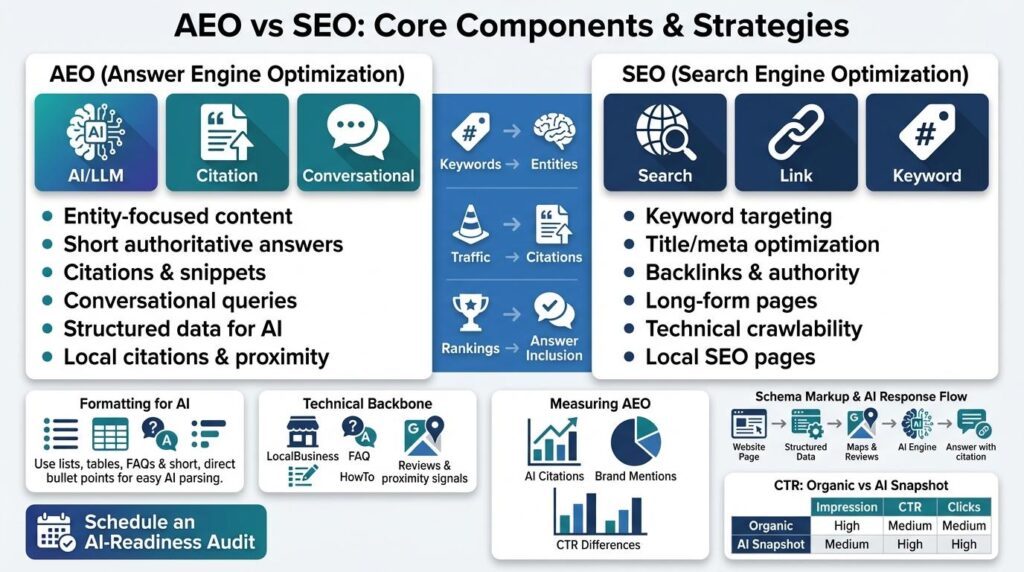
According to a recent analysis of AI Overview length by SE Ranking, the average text length of an AI-generated response has fluctuated, but the sources cited are typically those that provide a direct answer within the first 40 to 60 words of a section. For home service providers, this means providing the “bottom line” immediately, followed by the supporting technical details for the human reader who clicks through.
The Technical Backbone: Schema and Local SEO Integration
Successful answer engine optimization isn’t just about the words on the page; it is about how those words are packaged for machine consumption. While humans read for nuance and narrative, AI models—from Google’s Gemini to OpenAI’s SearchGPT—rely on a structured technical layer to verify facts and establish relationships between entities.
Why Schema Markup is the Language of AI
If your website is the book, Schema markup is the detailed index that tells the AI exactly what it’s looking at. For home service providers, this means moving beyond basic “Organization” tags and implementing nested JSON-LD that defines specific services, service areas, and technician credentials.
According to granular local schema research by Milestone, structured data significantly increases the likelihood of a business being selected as the primary “answer” in a conversational search result. By explicitly defining your business as a “Plumber” rather than just a “LocalBusiness,” you provide the categorical certainty AI requires.
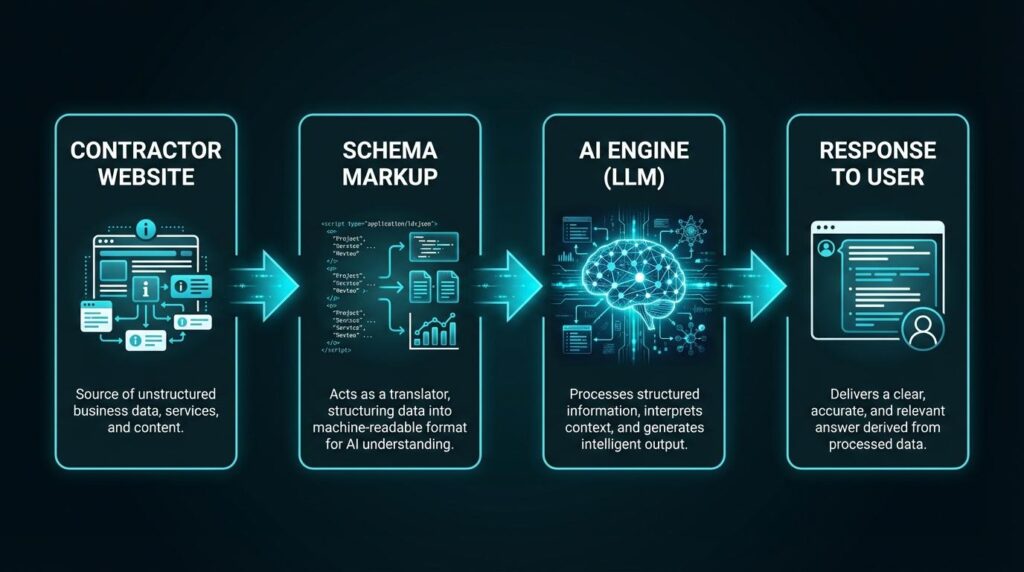
How Google Maps Feeds the Answer Engine
For local businesses, the Google Knowledge Graph—which powers many of Google’s AI-generated answers—draws heavily from Google Maps and your Google Business Profile (GBP). When a user asks an AI, “Who is the most reliable electrician near me open now?” the engine cross-references real-time map data with web content to generate a response.
To win these “near me” AI queries, you must ensure your Google Business Profile Optimization is airtight. This includes maintaining consistent NAP (Name, Address, Phone Number) data and high-frequency updates through GBP posts, which signal to the answer engine that your business is active and relevant.
Building Authority with E-E-A-T
Answer engines are designed to avoid “hallucinations” or providing dangerous advice, especially in the home services sector. To mitigate risk, they prioritize content that demonstrates E-E-A-T (Experience, Expertise, Authoritativeness, and Trustworthiness). For a contractor, this means your technical setup must highlight tangible proof of your work, such as verified reviews, licensing information, and professional affiliations.
Experience is now a critical differentiator in the age of AI-generated fluff. Search engines look for first-hand accounts, such as project galleries with original photos and detailed case studies that prove you have actually performed the work you describe.
Expertise and Authoritativeness are established when other reputable sites link back to your technical resources or when your team is mentioned as a source in industry publications. This “digital footprint” provides the secondary verification AI needs to trust your content.
Trustworthiness is the final hurdle. It is maintained through transparent business practices, such as clearly listed pricing (where possible), physical office addresses, and robust privacy policies. When an AI sees a high level of trust signals across the web, it is far more likely to recommend your business as the definitive solution to a user’s problem.
Measuring Success and Finding AEO Opportunities
To stay ahead in a landscape where answer engine optimization is becoming as critical as traditional SEO, home service businesses must shift how they identify opportunities and measure performance. With Gartner search volume projections suggesting a 25% decline in traditional search volume by 2026, the ability to capture “zero-click” visibility and AI citations is no longer optional—it is a necessity for survival.
Tools for Question Research
Finding the right questions to answer starts with understanding the conversational language your customers use. Unlike traditional keyword research, which focuses on short-tail terms like “plumber near me,” AEO research focuses on the “why” and “how.”
- AnswerThePublic: This tool is invaluable for visualizing the “cloud” of questions surrounding your core services. For example, a search for “HVAC repair” might reveal highly specific service queries like “Why is my AC blowing warm air at night?”
- Quora and Reddit: These platforms serve as real-world focus groups. Look for recurring problems or frustrations in local subreddits or home improvement forums to identify content gaps your website should fill.
- Google’s “People Also Ask” (PAA): Analyze these boxes for every major service you offer. Each PAA question is a direct signal of what Google considers a relevant “answer-based” query.
Tracking Mentions in LLMs
Tracking success in AEO is different because the “click” doesn’t always happen on your website; it happens in the user’s mind when an AI recommends you. While traditional tracking tools are still catching up, you can monitor your presence in Large Language Models (LLMs) through:
- Direct Prompting: Regularly test prompts in ChatGPT, Claude, and Perplexity. Use queries like, “Who are the best-rated residential electricians in [Your City]?” and note if your business is cited and what sources the AI uses to verify your reputation.
- Brand Mention Monitoring: Use tools like Google Alerts or specialized AI-tracking software to see when your brand is mentioned across the web. LLMs rely on “consensus” across multiple high-authority sites, so an increase in mentions usually precedes an increase in AI citations.
- Share of Voice in AI Responses: Document how often your brand appears in the top three recommendations for local service searches within AI chat interfaces.
Key Performance Indicators for AEO
To determine if your answer engine optimization strategy is working, you must look beyond traditional organic traffic. Focus on these three core KPIs:
| Metric | Why it Matters for Contractors |
| :— | :— |
| Citation Frequency | Measures how often AI models (like Perplexity) list your website as a source for their answers. |
| Direct Search Volume | An increase in people searching for your specific business name often follows a successful AEO campaign where an AI recommended you. |
| Conversion from “Zero-Click” | Tracking “calls from profile” or “website visits from AI” through UTM codes and call tracking to see the path from answer to lead. |
By focusing on these metrics, home service providers can move beyond the fear of declining search volumes and instead capitalize on the highly qualified leads generated by AI-driven recommendations.
The Intersection of Technical SEO and AI Visibility
Answer Engine Optimization (AEO) is not a replacement for traditional SEO; it is an evolution of it. To be visible in AI-driven results like ChatGPT or Google’s Search Generative Experience (SGE), your website must first be technically flawless. AI models rely on clean, accessible data to synthesize answers, meaning your technical infrastructure is the direct pipeline to AI visibility.
Why Technical Health Precedes AEO Success
AI crawlers and Large Language Models (LLMs) behave differently than traditional search bots, but they share a common requirement: data accessibility. If an AI agent cannot easily parse your site’s code, it will not use your business as a source for its answers.
Foundational Technical SEO for Home Services remains the bedrock of AEO for several reasons:
- Site Speed and Performance: AI engines prioritize efficient data retrieval. A slow-loading site can cause crawling timeouts, leading to incomplete indexing by AI agents.
- Structured Data (Schema Markup): This is the “native language” of AEO. By using Schema, you explicitly tell AI what your services are, where you are located, and what customers say about you.
- Mobile-First Architecture: Since most AI-driven queries happen on mobile or voice-activated devices, a non-responsive site is a major barrier to entry.
How Contractors Bridge the Gap
For home service businesses, bridging the gap between standard search rankings and AEO dominance requires a shift in how you manage your digital assets. It’s about moving from “ranking for keywords” to “becoming the definitive answer.”
Strategic Local SEO implementation serves as the bridge. By connecting your local signals—such as your Google Business Profile and local citations—with highly structured technical data on your website, you create a cohesive digital footprint that AI models can trust.
Key Action Items for Contractors:
- Standardize NAPD: Ensure your Name, Address, Phone Number, and Description are identical across all technical layers of your site and third-party directories.
- Entity Linking: Use your technical SEO to link your website to other authoritative “entities,” such as trade associations or local chambers of commerce.
- Clean Site Hierarchy: Ensure your services (Plumbing, HVAC, Roofing) are categorized in a logical hierarchy that AI agents can map instantly.
- By focusing on these technical pillars, you ensure that your business isn’t just “online”—it’s AI-ready.
Answer Engine Optimization FAQs
Do AI engines cite every source they use to generate an answer?
AI engines do not cite every source. While tools like Perplexity and Google Overviews highlight specific references to improve transparency, the underlying models are trained on vast datasets where individual sources are synthesized into a general knowledge base without specific attribution for every word.
How often do AI engines re-crawl sites for updated answers?
The frequency of re-crawling is determined by your site authority and the freshness of your content. While major AI models have training cut-offs, the search-integrated versions crawl the web continuously, often indexing updated service pages or blog posts within days to ensure responses reflect current market data.
Does AEO affect voice search results on devices like Alexa or Siri?
Answer Engine Optimization is the primary driver for voice search performance. Devices like Alexa and Siri utilize the same concise, structured data snippets that AEO targets to provide immediate verbal responses to user queries in a hands-free environment.
Can small local contractors outrank national brands in AI summaries?
Hyper-local relevance allows smaller contractors to outperform national brands in AI summaries. AI platforms favor businesses that demonstrate deep local expertise and maintain a strong presence in local directories, giving smaller firms a competitive edge in their specific service areas.
Is AEO more expensive to implement than traditional SEO?
Implementing AEO is not necessarily more expensive because it relies on many of the same foundational elements as traditional SEO. The primary difference lies in the strategic focus on structured data and conversational content, which are essential for maintaining a strong digital footprint as search behavior evolves.
Secure Your Digital Presence
The shift toward generative search requires a proactive approach to ensure your business remains the top choice for local customers. By prioritizing a comprehensive home service SEO strategy, you can align your technical infrastructure with the evolving requirements of AI platforms. Schedule an AI-Readiness Audit for your home service business to see how your brand appears in AI Overviews and ChatGPT results and take control of your search visibility today.