
Your ability to win in modern search—from traditional Google rankings to emerging AI Overviews—hinges on establishing Topical Authority. This concept is no longer just about gaining backlinks; it is about becoming the verified, comprehensive expert in your specific service niche, convincing search engines and large language models that you are the definitive source for customer queries.
Before adding more niche articles, align them to a clear contractor SEO guide so supporting pages reinforce the same service-area, authority, and conversion goals. Learn more about electrician SEO strategies for contractors.
Building topical authority works best when every supporting article points back to a clear service-intent hub, such as a focused contractor SEO resource that connects services, locations, proof points, and AI-search visibility.
That moat gets stronger when your team understands the difference between AEO vs SEO and builds content for both search rankings and answer extraction.
You must learn to contrast this depth-focused approach against older backlink metrics, understand how to structure content around core service entities, and determine the strategic focus—residential versus commercial—that yields the highest return on investment. We will also cover the exact content quality standards required to satisfy both human readers and automated systems, ensuring that your site architecture perfectly supports your newfound expertise. Mastering these principles is the key to securing high-intent organic traffic and positioning your contracting business as the recognized leader in your service area.
Understanding Topical Authority for Home Service Contractors
For home service businesses, topical authority is the measure of your website’s perceived expertise on a specific niche—whether that is residential roofing, emergency plumbing, or high-efficiency HVAC systems. Unlike broad SEO strategies, building topical authority tells search engines that you aren’t just a generalist; you are a trusted source of comprehensive information for your trade.
Defining Topical Authority vs. Domain Authority
While domain authority (DA) often focuses on the quantity and power of external backlinks, topical authority focuses on the depth and quality of your content. A high DA can help you rank for competitive terms, but it doesn’t guarantee you’ll be seen as an expert in a specific geographic or service niche.
To build this credibility, contractors must align their content with Google Search Central documentation on E-E-A-T. By answering every possible question a customer might have about a service, you signal to algorithms that your site is the most reliable destination for that specific topic.
Why Topical Authority Matters for Google and AI Overviews
Search has evolved from simple keyword matching to understanding entities and intent. With the rise of AI Overviews (formerly SGE) and Large Language Models (LLMs), Google no longer just lists links; it synthesizes answers directly for the user.
If your website covers the "how-to," "cost," "benefits," and "maintenance" of a specific service across dozens of interlinked pages, AI models are more likely to cite your business as the definitive source. For a contractor, this means moving beyond a single "Services" page and building a robust ecosystem of knowledge that proves you are the local leader in your field.
How Authority Signals Influence Ranking
Authority signals are generated through a combination of content depth and internal linking structures. When you create a pillar page supported by multiple sub-topic articles—such as "Common Causes of Roof Leaks" or "When to Replace Your Water Heater"—you create a "topical map" that search engines crawl to understand your specialty.
Beyond the text, external signals like customer reviews, mentions on trade-specific sites, and verified business profiles reinforce your standing. These signals tell Google—and AI models—that your business is not just a digital entity, but a real-world expert in the home services industry.
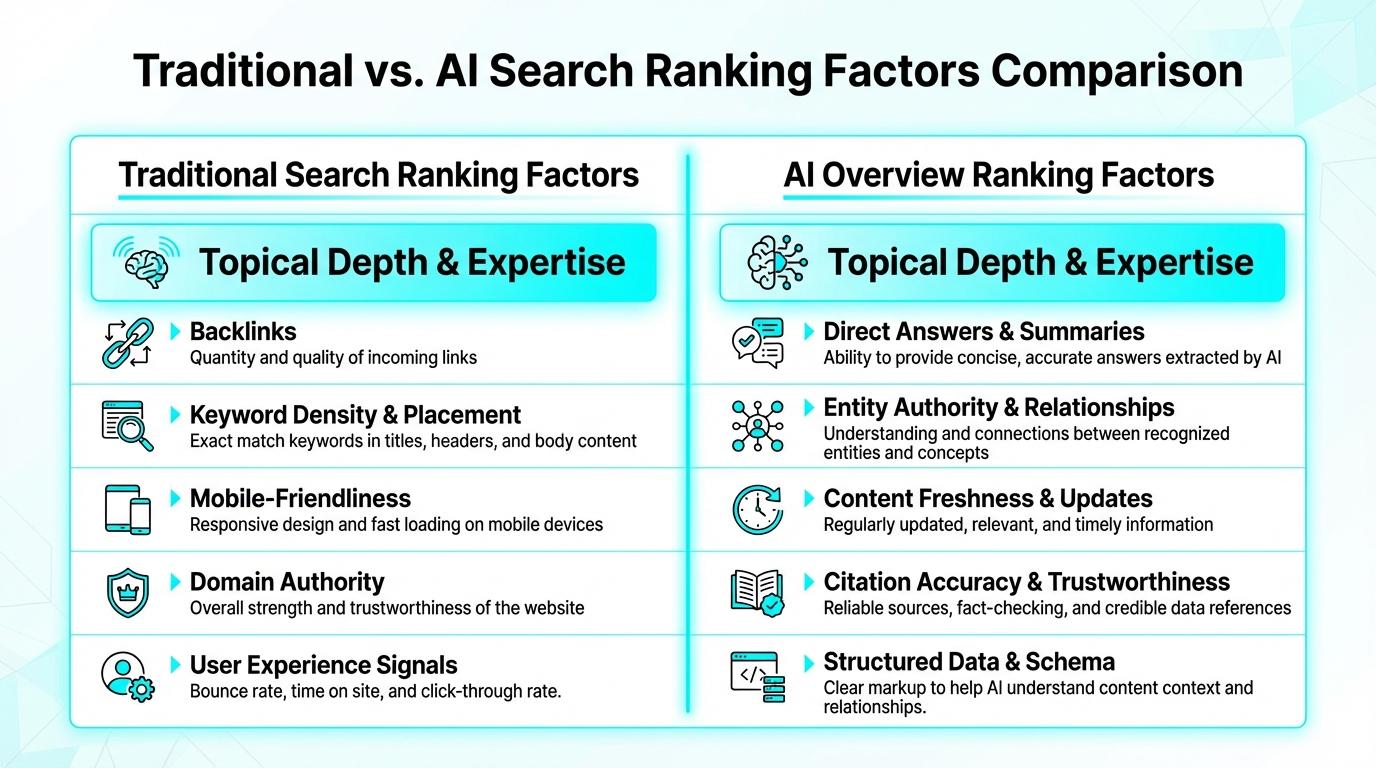
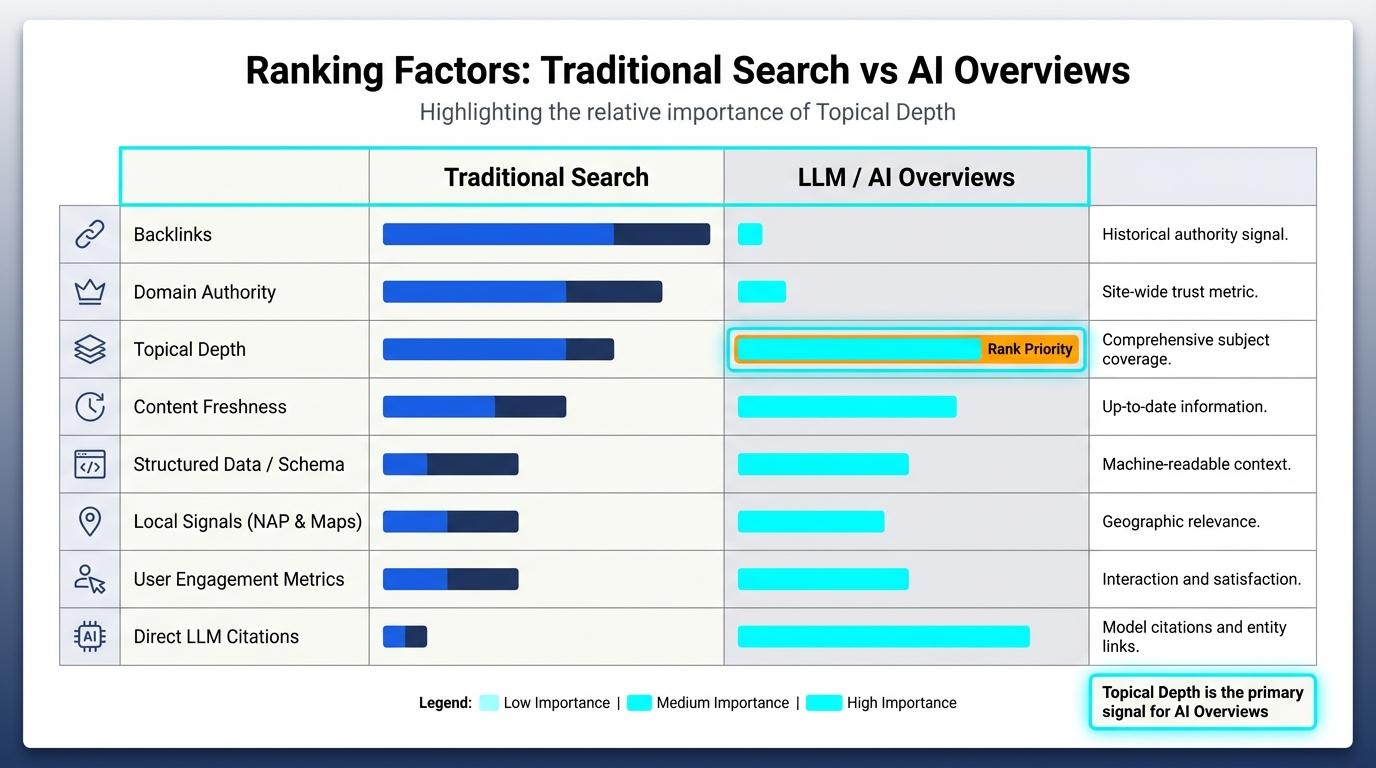
| Ranking Factor | Traditional Search (Blue Links) | LLM / AI Overviews (AEO) |
| :— | :— | :— |
| Primary Goal | Direct traffic to a specific URL. | Synthesize an answer from multiple sources. |
| Keyword Strategy | Matching specific search queries. | Understanding semantic relationships and entities. |
| Backlink Importance | High (Quantity and Authority of links). | Moderate (Relevance and Citation frequency). |
| Content Depth | Important for "Length" signals. | Critical for "Source Selection" and citation. |
| Local Signals | Google Business Profile & Proximity. | Verified expertise and service-area authority. |
| User Intent | Information vs. Transactional navigation. | Direct problem-solving and decision support. |
Creating a Topical Map: The Blueprint for Contractor Search Dominance
A topical map is the strategic foundation of your content. For contractors, it acts as a visual and logical representation of your expertise. Instead of chasing individual keywords, you are building a web of interconnected information that proves to Google you are the definitive source for your trade.
Identifying Your Core Pillars
The first step in building a topical map is identifying your core pillars. These are the broad, high-level categories that represent your primary services. For a general contractor, pillars might include "Kitchen Remodeling," "Bathroom Renovations," and "Home Additions."
Each pillar should be substantial enough to support dozens of smaller, more specific sub-topics. By centering your strategy on these pillars, you ensure your website structure is intuitive for both human users and search engine crawlers. This structure establishes a clear information hierarchy, making it easier for Google to categorize your site.
Case Study: The Pillar and Cluster Model for a Plumber
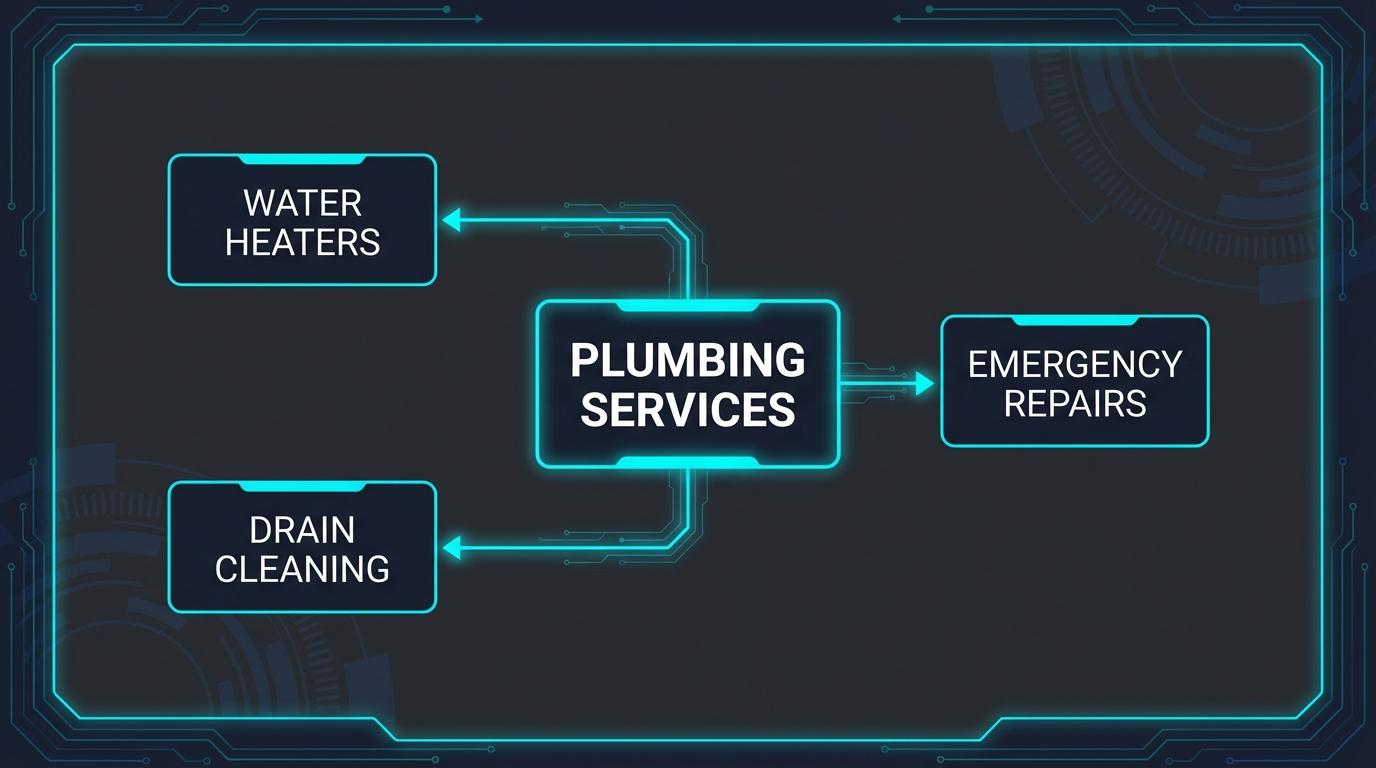
To see this in action, let’s look at a plumbing company focusing on the pillar: Drain Cleaning Services.
Instead of just having one page about drain cleaning, the contractor builds a topic cluster around it. This cluster includes supporting articles that answer every possible question a customer might have. By linking these "cluster" pages back to the main "pillar" page, you create a powerful semantic signal. This approach is rooted in the principles found in this Search Engine Journal or Moz article on Entity SEO, which explains how search engines now prioritize related concepts over simple keyword matching.
For this plumber, the cluster might include:
- Hydro-jetting vs. Snaking: Which is right for your home?
- 5 Signs Your Main Sewer Line is Clogged.
- How to Prevent Kitchen Sink Clogs During the Holidays.
- The Cost of Emergency Drain Cleaning in .
Steps to Conduct a Content Gap Analysis
A content gap analysis helps you identify what your competitors are talking about that you aren’t. It reveals the "missing links" in your topical map. Follow these steps to bridge the gap:
- Audit your current content. List every service page and blog post you currently have live.
- Analyze top-ranking competitors. Use SEO tools to see which topics your competitors rank for that you lack.
- Map topics to the buyer’s journey. Identify if you are missing "Top of Funnel" educational content or "Bottom of Funnel" service-specific details.
- Identify semantic keywords. Look for related terms and questions that naturally belong within your existing pillars.
- Prioritize based on conversion potential. Rank your missing topics by how likely they are to generate a lead or phone call.
- Create a content calendar. Schedule the production of these missing pieces to complete your topical map.
Strategy: Deciding What Topics to Own as a Local Contractor
The first step in building topical authority for contractors isn’t writing—it’s strategic selection. Google’s algorithms, particularly those powering Local SEO for contractors, look for the density of your expertise. You cannot be the authority on everything at once; you must choose which "nodes" in your topical map to prioritize to signal relevance to both search engines and potential clients.
Generalist vs. Specialist: Who Wins the Authority Race?
In the competitive landscape of home services, a specialist almost always outranks a generalist for high-value terms. If your website covers 50 different services superficially, search engines may view you as a "Jack of all trades, master of none." However, if you focus your topical map on a core vertical—such as HVAC, Roofing, or Plumbing—you can build a dense cluster of content that signals deep, authoritative expertise.
For contractors looking to scale, the goal is to become the dominant entity in a specific niche before expanding. This ensures that your primary "service node" is so well-supported by sub-topics—including FAQs, maintenance tips, and safety guides—that search engines recognize your site as the definitive resource for that service in your area.
Residential vs. Commercial Authority Building
Deciding between residential and commercial markets fundamentally changes your topical map density. The volume and type of content required to "own" a topic differ based on the audience’s intent.
- Residential Authority: This requires a high density of "problem-solution" content. Homeowners often search for immediate, emotional needs or DIY troubleshooting. To own this space, your topical map needs many "thin" branches covering a wide variety of specific household issues (e.g., "clogged sink tips" or "seasonal AC prep").
- Commercial Authority: This requires fewer but much deeper "technical-compliance" nodes. Commercial clients are looking for reliability, certifications, and long-term ROI. Your content density here should focus on authoritative guides regarding building codes, preventative maintenance contracts, and large-scale project management.
By choosing a primary focus, you concentrate your "authority budget" on the areas that drive the highest ROI, preventing your site’s relevance from being diluted across two very different search intents.
High-Intent Keyword Anchors for Your Map
Your topical map must be anchored by high-intent keywords that move the needle for your business. These "money phrases" indicate a user is ready to hire and should serve as the pillars for your supporting content. When building your map, ensure your main service pages are optimized for localized, high-intent variations such as:
- "24/7 Emergency AC Repair in [City]"
- "Professional Kitchen Remodeling Contractors [City]"
- "Commercial Roof Leak Detection [City]"
- "Licensed Residential Plumber Near [City]"
- "Full-Service Home Addition Specialists in [City]"
By anchoring your informational content (such as "How to spot a roof leak") to these localized service pages, you create a powerful internal linking structure that transfers authority from your educational blog posts directly to your lead-generation pages.
Content Execution and the Role of AI in Authority Building
Establishing topical authority for contractors requires moving beyond keyword lists and into the realm of high-quality execution. It isn’t enough to know what to talk about; you must publish content that demonstrates your real-world experience and satisfies both human readers and search engine algorithms.
Do You Need a Blog to Build Authority?
The short answer is a definitive yes. However, the traditional "blog" as a chronological list of company news is largely dead. To win in today’s search landscape, your website needs a Resource Center or Learning Hub.
While your service pages tell customers what you do, your Resource Center proves how much you know. By consistently answering the specific questions your customers ask during the sales process, you create a library of content that Google views as a comprehensive knowledge base. This shift from a "blog" to a "Resource Center" ensures that every post serves a strategic purpose in your topical map, rather than just being filler content.
The Truth About AI Content and Search Rankings
Artificial Intelligence has revolutionized how quickly we can produce drafts, but it has also created a sea of "average" content that fails to rank. Google’s algorithms are increasingly sophisticated at identifying content that lacks E-E-A-T (Experience, Expertise, Authoritativeness, and Trustworthiness).
Disclaimer on AI Utilization: While AI can be a powerful tool for outlining and researching, all AI-generated content must be human-edited and enhanced to meet modern authority standards. Purely AI-generated text often lacks the nuanced "Experience" component of E-E-A-T—such as specific local knowledge, project-specific insights, and the unique brand voice that only a professional contractor can provide. For a deeper look at how AI models categorize information, see our guide on Answer Engine Optimization.
5 Content Types That Build Maximum Authority
To dominate your local market, your content strategy should focus on these five actionable formats. Each is designed to showcase your expertise while providing genuine value to the user:
- Comprehensive How-To Guides: Provide step-by-step instructions for minor repairs or maintenance tasks. For example, "How to Prepare Your HVAC System for a Florida Summer." These establish you as a helpful expert before a major repair is ever needed.
- Project Spotlights (Case Studies): Move beyond a simple photo gallery. Write about a specific problem a local client had, the solution you implemented, and the final result. This proves your real-world experience in specific neighborhoods.
- Local Cost and Pricing Guides: Be transparent about what home services cost in your specific service area. Use tables to compare different material grades or service levels.
- Maintenance Checklists: Create downloadable or highly scannable checklists (e.g., "The Annual 15-Point Roof Inspection Checklist"). These are high-utility items that users often bookmark and share.
- Regulatory and Compliance Updates: Explain local building codes, permit requirements, or new energy efficiency tax credits. This positions your firm as the leading authority on the technical and legal side of SEO for home services.
Advanced Internal Linking and Local SEO Signal Integration
Establishing topical authority isn’t just about writing great content; it is about how you connect that content to show Google you are the local expert. By organizing your website logically and linking it to your physical business location, you create a powerful web of relevance that is hard for competitors to break.
The ‘Silo’ Internal Linking Strategy for Contractors
For a contractor, a "Silo" is simply a way of grouping related topics together so search engines understand your expertise. Instead of having a messy pile of random blog posts, you organize them like folders in a filing cabinet. This structure guides both users and search bots through a logical journey of information.
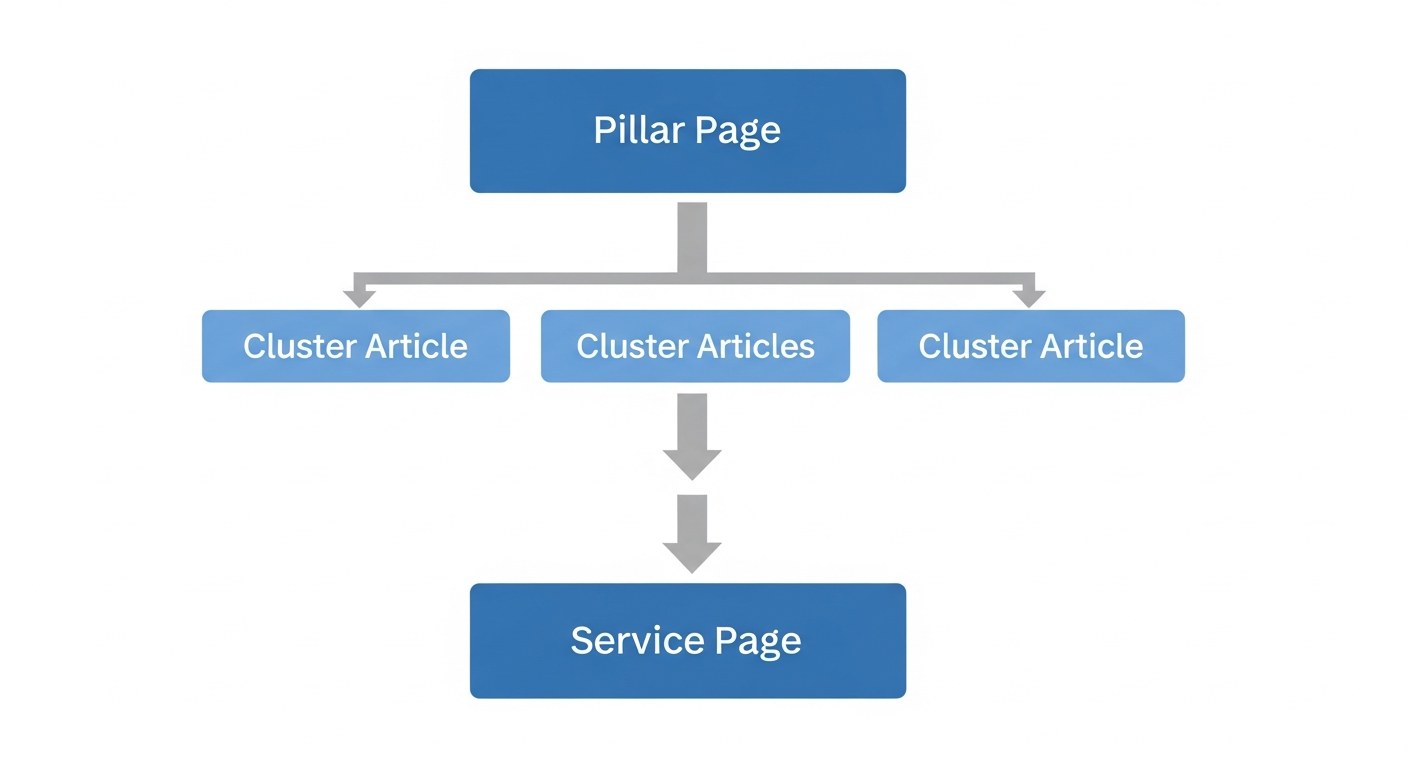
To visualize how your website should flow, follow this path:
Pillar Page (The Main Topic) -> Cluster Content (Supporting Guides) -> Service Page (The Specific Solution)
For example, if your pillar page is about "Kitchen Remodeling," your cluster content might include "Top 10 Countertop Materials" or "How to Choose Cabinets." These should all link back to your main Kitchen Remodeling service page. Using a structured SEO for home services approach ensures that every new blog post adds "ranking power" to your primary business pages.
Connecting Content to Google Maps Authority
Your website and your Google Business Profile must work in perfect harmony. Google looks for a match between what you say on your site and what your business profile shows. When you write about a specific project in a specific city, you are creating a "local signal" that strengthens your presence in the Map Pack.
A critical factor here is NAP (Name, Address, Phone) consistency. Your business name, physical address, and phone number must be identical across your website, social profiles, and directory listings. Any discrepancy can confuse Google and lower your local ranking.
When you link your service pages to your location-specific content, you help Google confirm that you are a legitimate local authority. Building strong Google Map SEO requires you to embed your map on your contact page and link to your profile from relevant blog posts. This tells the algorithm that your business is the most relevant answer for local searches.
Using Local Trust Signals to Boost Topical Depth
Topical depth isn’t just about industry keywords; it is about proving you are active in your community. Local trust signals—such as mentions of local landmarks, neighborhoods, and community events—help distinguish you from national companies that don’t actually have "boots on the ground" in your area.
To truly dominate your area, your content should reflect the specific needs of your local clients. Whether it’s discussing how the local climate affects roofing or mentioning building codes in your specific county, these details matter. Implementing a dedicated strategy for local SEO for contractors ensures that your topical map is grounded in geographic reality, making your business the go-to choice for both search engines and local homeowners.
Measuring ROI: How to Track Your Authority Growth
Building topical authority for contractors is a strategic investment rather than a quick fix. Unlike a one-off ad campaign, authority accumulates over time, creating a "moat" around your business that competitors cannot easily replicate. To ensure your efforts are yielding results, you must track the right metrics across both traditional search engines and emerging AI platforms.
How Long Does It Take to Build Topical Authority?
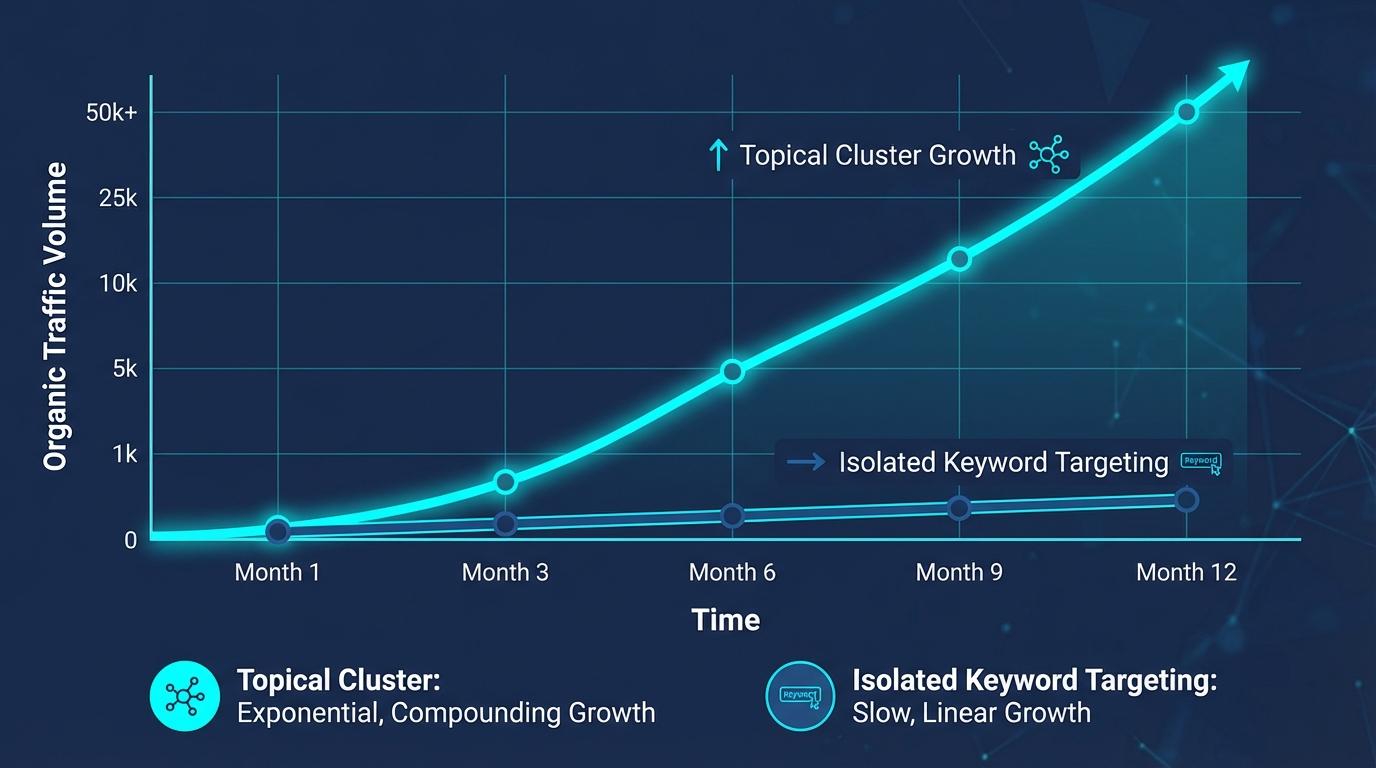
While a single blog post might rank for a low-competition "long-tail" keyword within weeks, true topical authority typically takes 3 to 6 months to manifest in a meaningful way. This timeline allows search engines to crawl your entire content library, recognize the semantic relationships between your pages, and establish your brand as a reliable source of truth in the home service industry.
During this period, you will see a shift from ranking for individual, isolated keywords to seeing your entire website "lift" across a broad range of related terms.
KPIs for Authority: Rankings, Impressions, and LLM Citations
To measure the health of your authority strategy, you need to look beyond just the "number one" spot for a single term. A high-performing topical map produces growth across three primary areas:
- Cluster Rankings: Instead of tracking one keyword like "roofing contractor," track the aggregate movement of a cluster (e.g., "roof repair," "shingle replacement," "hail damage inspection").
- Search Impressions: An early indicator of success is a surge in Google Search Console impressions. This means Google is testing your content for more queries even before the clicks follow.
- LLM Citations: In the era of Answer Engine Optimization (AEO), a critical KPI is how often your brand is cited by Large Language Models (LLMs) like ChatGPT, Claude, and Google’s AI Overviews. LLM Citations are instances where an AI model identifies your business as the expert recommendation when a user asks a question like, "Who is the most trusted HVAC expert for energy efficiency in Dallas?"
By monitoring these citations, you can gauge your influence within the AI-driven search ecosystem that modern homeowners are increasingly using to vet local contractors.
Distinguishing Authority from Keyword Stuffing
A common mistake in contractor SEO is confusing authority with keyword density. The broader home services SEO playbook should connect each topical cluster back to service-area, proof, and conversion pages. In the current AI-first era of search, keyword stuffing—the practice of over-optimizing a page by repeating phrases like "plumber in Chicago" dozens of times—is a high-risk tactic that can lead to manual penalties or total suppression in search results.
Modern search algorithms use Natural Language Processing (NLP) to understand the intent and depth of your content. To build authority without the risks of over-optimization, focus on these principles:
- Semantic Relevance over Repetition: Instead of repeating the same keyword, use related terms that experts naturally use (e.g., if writing about water heaters, include "anode rods," "sediment buildup," and "thermal expansion").
- User-Centric Depth: Google’s Helpful Content guidelines prioritize pages that actually answer a user’s question. If your page is 2,000 words of repetitive fluff, it will be outperformed by a 500-word page that provides a clear, expert solution.
- Entity Association: Authority is built by connecting your brand to the "entities" of your trade. High-quality links and mentions from industry-specific associations do more for your authority than any amount of keyword-rich text ever could.
By focusing on genuine expertise rather than gaming the system, you position your home service business to dominate both current search results and the future of AI-driven discovery. For more insights on scaling your digital presence, explore the strategies offered by Growth Pro Agency.
The Synergy Between Semantic Content and Technical SEO Foundations
Why Technical Architecture is the Vehicle for Topical Content
High-quality content is meaningless if search engines cannot crawl and categorize it efficiently. For contractors, site architecture serves as the foundational framework that organizes topical clusters. A clean, logical hierarchy ensures that Google’s crawlers—and AI training models—can follow the semantic relationship from a broad category, such as "Kitchen Remodeling," down to niche sub-topics like "Quartz countertop durability" or "Under-cabinet lighting trends."
A flat or disorganized site structure dilutes topical authority, making it difficult for search engines to identify which pages are the primary pillars of your expertise. By aligning your technical URL structure with your topical map, you create a "crawl-friendly" environment that reinforces your standing as a subject matter expert in the home services industry.
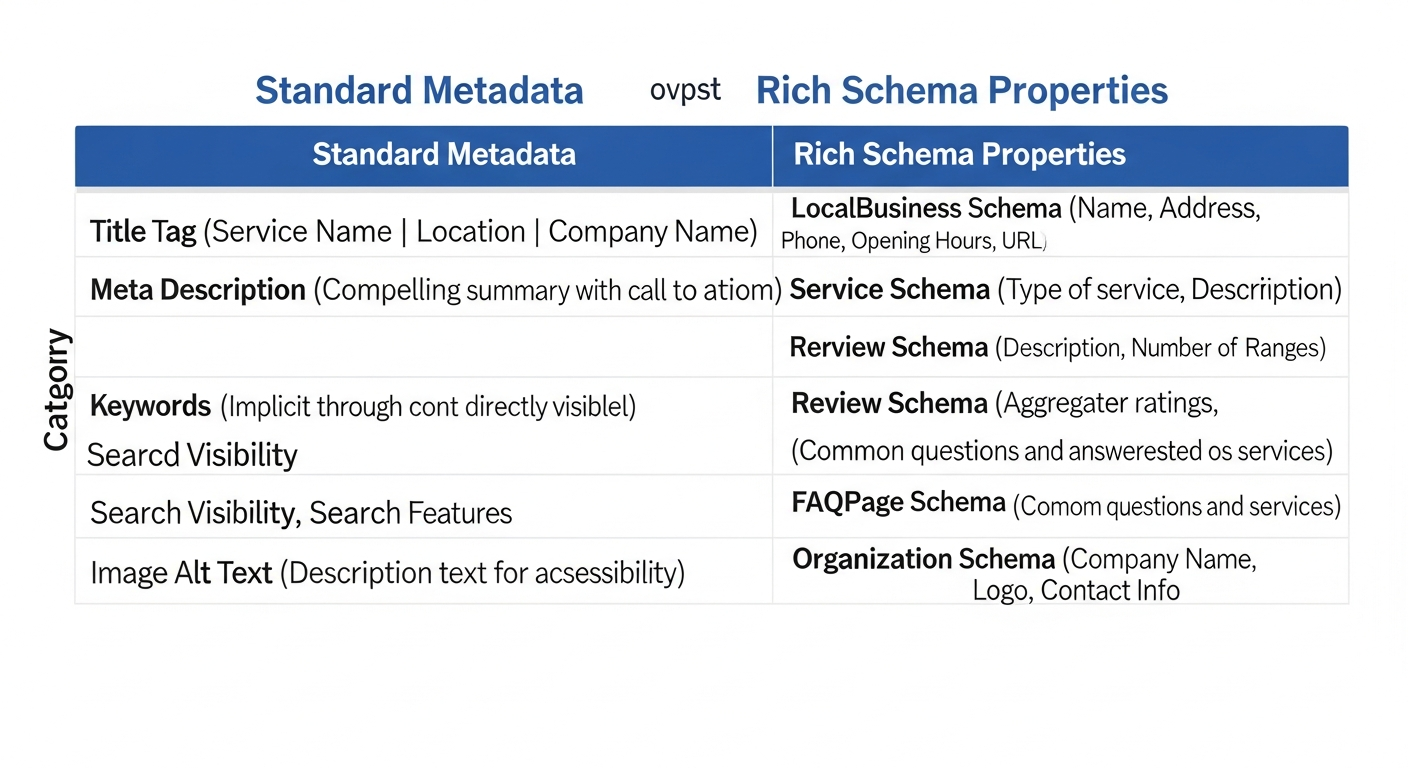
How Schema Markup Bridges the Gap Between Authority and AI
Structured data acts as a translator, turning human-readable content into machine-understandable data points. To dominate local search and appear in AI-generated answers, contractors must utilize specific Schema Markup to define their entities.
Implementing LocalBusiness and Service schema is non-negotiable for modern contractor SEO. These tags provide explicit signals about your physical location, service area, and specific offerings. By providing this level of granular data, you bridge the gap between simple content coverage and the advanced AEO techniques and technical SEO signals required to rank in the age of Answer Engine Optimization.
Moving from Content Coverage to Advanced AEO Optimization
Achieving topical authority for contractors requires moving beyond traditional keyword density and focusing on Answer Engine Optimization (AEO). While SEO focuses on ranking in a list of links, AEO focuses on being the definitive answer provided by AI agents like ChatGPT, Claude, and Google’s Search Generative Experience (SGE).
This transition requires a synthesis of semantic depth—answering the "how" and "why" of home improvement—and technical performance. When your technical foundations (speed, security, and mobile-first design) meet a comprehensive topical map, you create a "Knowledge Graph" for your business. This makes your brand the most reliable source of information, ensuring you remain visible as search evolves from a list of blue links into a conversational interface.
Ready to see where your strategy stands? Request your Free Topical Authority Audit to identify gaps in your content and technical foundations.
Topical Authority for Contractors FAQs
What happens if I try to build authority across too many home service subjects at once?
Attempting to cover too many unrelated subjects simultaneously often results in a diluted signal to search engines. For a home service business, this leads to a lack of depth in any single area, making it difficult for Google to categorize your site as an expert. It is generally more effective to achieve complete coverage in one core service before expanding to the next to ensure your entity remains focused and authoritative.
How many articles do I need to establish authority in a specific service category?
There is no universal number, as the requirement depends entirely on the complexity of the service and the level of local competition. A simple service might only require five to seven deeply interlinked pages, while a complex category like full kitchen remodeling could require twenty or more pieces of content covering design, materials, permits, and plumbing. The goal is to answer every logical question a customer or search engine might have about that specific niche.
What is the difference between topical authority and keyword stuffing?
Keyword stuffing is an outdated tactic that focuses on repeating specific phrases to manipulate rankings, whereas topical authority focuses on the breadth and depth of information provided. Topical authority is built by discussing related concepts, entities, and subtopics that naturally surround a core service. While keyword stuffing often leads to poor user experiences and search penalties, building authority provides genuine value that satisfies modern intent-based search algorithms.
How does Google judge a general contractor’s topical authority versus a specialist like an HVAC company?
Google evaluates a general contractor based on their ability to show breadth across various construction phases, whereas a specialist is judged on extreme depth within a narrow vertical. An HVAC company must demonstrate exhaustive knowledge of heating, cooling, and air quality systems to rank. For a generalist, the challenge lies in proving they possess the management and technical oversight for multiple trades without losing the specific expertise required for each individual service they list. Evaluating these nuances is a key part of identifying how your business stacks up against the competition.
Analyze Your Local Authority Gap
Understanding your current standing in the digital landscape is the first step toward dominating your local market. Schedule a free topical authority audit to see how your current content compares to your top local competitors and identify exactly where your biggest entity gaps are preventing you from ranking.