
Table of Contents
Mastering Water Damage SEO for Business Growth
In the fast-paced world of water damage restoration, emergencies strike without warning, from sudden pipe bursts to severe flooding. Struggling to get noticed during these crises? Effective water damage SEO can transform your business by boosting visibility and attracting qualified leads when homeowners desperately search for help. This approach helps restoration companies stand out in a crowded market, turning urgent queries into reliable revenue streams.
The demand for water damage restoration services continues to surge, driven by increasing incidents of floods and plumbing failures. Yet, many contractors miss out on potential clients typing ‘water damage restoration services near me’ into search engines due to poor online presence. Water damage SEO addresses this by focusing on local optimization and relevant content, driving organic traffic and generating cost-effective leads without hefty ad spends. According to SEO experts in water damage restoration, optimized websites can rank higher during emergencies, potentially increasing leads by up to 300 percent. Investing in these strategies offers strong returns, with agencies like growth pro agency seo providing tailored solutions to fit various budgets.
This guide explores the fundamentals of water damage SEO, its key benefits, step-by-step implementation processes, and proven best practices. By mastering flood damage search optimization, you’ll enhance your restoration business online visibility and achieve sustainable growth in competitive local markets.
Fundamentals of Water Damage SEO
Water damage restoration involves a systematic process to mitigate and repair properties affected by floods, leaks, or bursts. The typical water damage restoration process starts with immediate water extraction using pumps and vacuums, followed by drying with industrial fans and dehumidifiers to prevent mold growth. Then, damaged materials like carpets and drywall are removed, and antimicrobial treatments are applied for sanitation. Finally, structural repairs and content restoration bring the property back to its pre-loss condition. Understanding this urgency underscores the need for effective SEO strategies that position restoration businesses to capture emergency searches quickly.
Core Components of Water Damage SEO
Water damage SEO focuses on optimizing online presence for queries related to restoration services, helping businesses rank for high-intent searches during crises. At its foundation, keyword research identifies terms like long-tail phrases such as ‘water damage restoration near me’ that reflect user urgency. Tools analyze search volume and competition to prioritize these, ensuring content aligns with what affected homeowners seek. On-page optimization follows, incorporating relevant keywords into meta tags, headers, and body text while crafting informative pages about restoration steps to build trust.
For example, a restoration company might target ’emergency flood optimization’ by creating a dedicated page outlining the water damage restoration process, from assessment to reconstruction. Restoration SEO strategies also emphasize content relevance, debunking myths like instant fixes without professional intervention. This approach not only improves visibility but educates users on the value of prompt, expert services. By integrating these core elements, businesses establish topical authority in water damage SEO.
Local Search Dynamics in Restoration Services
Google prioritizes local results for queries like ‘water damage restoration services near me in your area,’ displaying a map pack with nearby businesses based on relevance, distance, and prominence. This dynamic favors companies with optimized Google My Business profiles, which act as a central hub for displaying contact info, hours, and services like 24/7 emergency response. Consistent name, address, and phone number citations across directories such as Yelp and Angi reinforce local signals, boosting rankings in geo-targeted searches.
Reviews play a crucial role too, as positive feedback from past clients signals reliability during emergencies. Businesses should encourage satisfied customers to leave detailed testimonials highlighting quick response times and thorough restoration work. To illustrate the difference:
| Aspect | Organic Local Results | Paid Local Ads |
|---|---|---|
| Cost | Free, long-term build | Pay-per-click |
| Visibility | Map pack integration | Top ad placement |
| Trust | Relies on reviews | Can seem promotional |
Organic efforts yield sustainable traffic, while paid ads provide immediate visibility. Implementing these local tactics, drawn from proven citation strategies, helps restoration firms dominate searches and connect with distressed locals effectively.
Technical SEO for Restoration Websites
Technical SEO ensures restoration websites perform reliably, directly impacting rankings for urgent water damage queries. Site speed optimization compresses images and leverages caching to load pages in under three seconds, reducing bounce rates during stress-induced searches. Mobile optimization is equally vital, as over 60 percent of local searches occur on smartphones; responsive design adapts layouts for seamless navigation on any device.
Schema markup adds structured data, like local business and service schemas, to help search engines display rich snippets such as ratings or availability hours. Implementing HTTPS secures the site, fostering user trust and meeting Google’s security standards. These setups prevent common pitfalls, like slow loading that frustrates users needing immediate water damage restoration help.
The benefits include higher click-through rates from enhanced search features and improved crawlability, leading to better indexing of service pages. For instance, a well-optimized site might rank prominently for ‘water damage restoration services near me,’ driving qualified leads and hinting at the ROI potential of these foundational investments.
Advantages of Investing in Water Damage SEO
Investing in water damage SEO offers restoration companies a strategic edge in a competitive market driven by urgent needs. This approach enhances online presence, attracting clients during emergencies like floods or bursts without relying solely on paid promotions. Businesses see sustained growth through organic channels that align with search behaviors, ultimately supporting scalable operations in regions like St. Louis.
Increased Lead Generation and Visibility
SEO drives qualified leads by optimizing for high-intent searches, such as those for water damage restoration services near me in local areas. When emergencies strike, potential clients turn to search engines first, and top rankings ensure restorers appear prominently around the clock. This visibility translates to more inquiries without the constant expense of ads, focusing instead on content that addresses immediate concerns like rapid response times.
For instance, a restoration firm optimizing for emergency keywords can capture traffic from users seeking fast solutions, leading to a steady influx of calls. Unlike fleeting ad campaigns, SEO builds a foundation for ongoing discovery, helping businesses handle fluctuating demands efficiently. In practice, companies report up to 300 percent increases in leads after implementing targeted strategies, demonstrating the power of organic reach.
Understanding these dynamics highlights why comparisons between marketing methods are essential for restorers evaluating options. The following table outlines key differences, drawing from industry insights on performance metrics.
| Aspect | SEO | Paid Ads | Offline Marketing |
|---|---|---|---|
| Cost Efficiency | Ongoing but low after setup | High initial spend | Variable, location-dependent |
| Lead Quality | High-intent organic traffic | Targeted but competitive | Broad reach, lower intent |
SEO stands out for water damage businesses by delivering sustainable results over time. Data indicates SEO yields 14.6 percent of traffic compared to 1.7 percent for PPC in local services, emphasizing its efficiency for long-term lead generation. Restoration firms benefit from this edge, as organic methods reduce dependency on budgets while maintaining visibility during peak seasons. This positions SEO as a reliable choice for consistent growth amid unpredictable emergency calls.
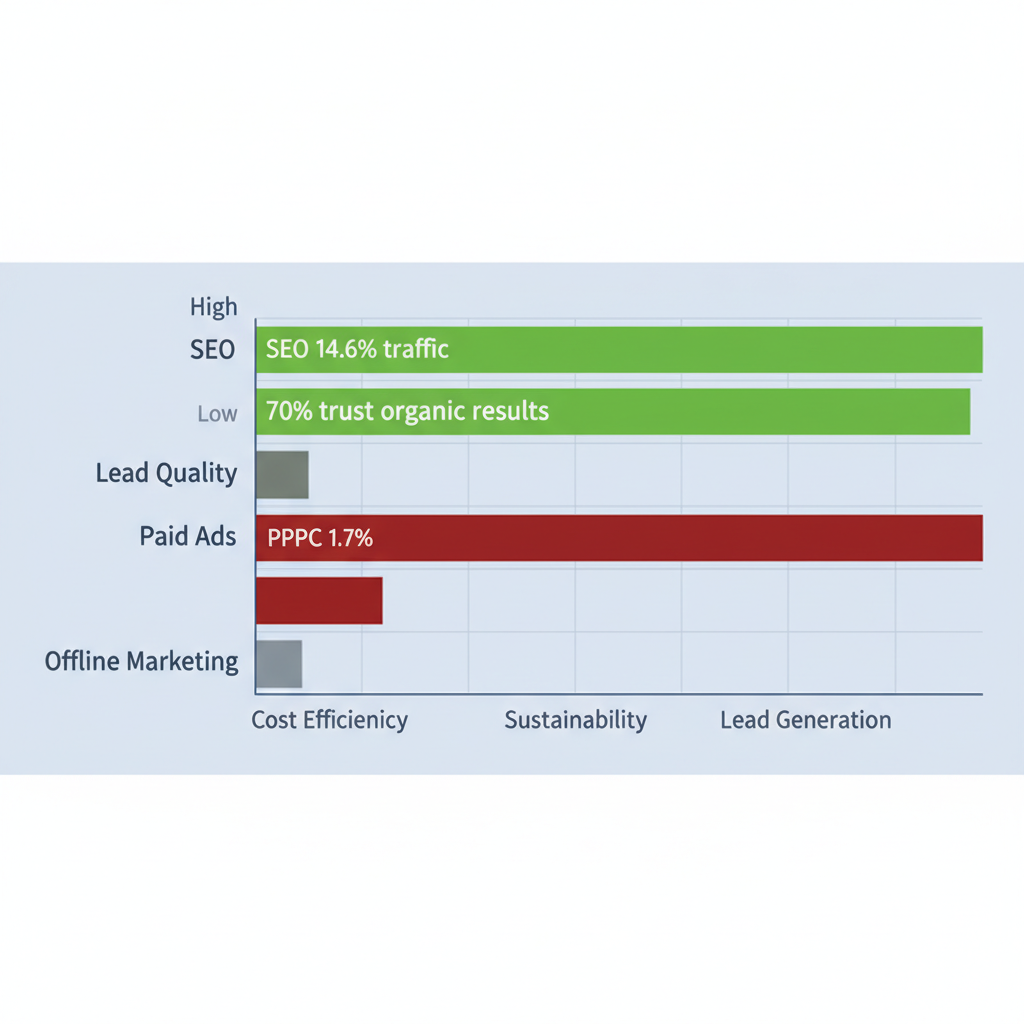
SEO outperforms paid and offline marketing in cost, quality, and sustainability for restoration businesses.
Transitioning to financial aspects, these advantages extend to broader operational efficiencies. Restoration leaders can leverage such comparisons to prioritize investments that yield measurable returns.
Long-Term Cost Savings for Restoration Businesses
Water damage restoration demands quick action, but marketing budgets can strain resources without strategic planning. SEO provides budget efficiency by minimizing ongoing costs after initial optimization, contrasting with pay-per-click models that accumulate expenses rapidly. For example, while PPC might cost thousands monthly for competitive keywords like water damage restoration, SEO investments pay off through enduring rankings, often achieving positive ROI within six to twelve months.
Consider a typical scenario: A mid-sized restorer allocates $5,000 upfront for SEO, seeing lead costs drop to under $50 per conversion versus $200-plus in ads. Reference 2 notes that SEO’s lead conversion rates outperform paid options by focusing on qualified traffic, reducing ad waste on low-intent clicks. This approach allows firms to redirect savings toward service enhancements, like better equipment for mold prevention, ensuring profitability even in off-peak periods.
- Initial audit and optimization: Builds a strong site foundation.
- Content updates: Keeps rankings fresh without recurring fees.
- Monitoring tools: Tracks performance at minimal cost.
Building Trust Through Local Rankings
Top local rankings for water damage restoration services near me in urban areas signal reliability to potential clients facing crises. Consumers perceive organic results as more trustworthy, fostering credibility that encourages direct contact and positive reviews. This trust loop amplifies visibility, as satisfied customers contribute testimonials that further boost search positions.
Reference 3 highlights that 70 percent of consumers prefer organic results over ads, underscoring SEO’s role in building long-term relationships. A St. Louis-based firm, for instance, climbed to page one, resulting in a surge of five-star reviews and repeat business. Timely responses enabled by SEO not only prevent issues like mold growth but also solidify community reputation, turning one-time fixes into loyal referrals.
To maximize this, restorers should encourage post-service feedback and integrate it into site content, enhancing both trust and rankings over time.
The Water Damage SEO Process Explained
Implementing a solid water damage SEO strategy transforms how restoration businesses attract urgent leads online. This process mirrors the swift action needed in water damage restoration, where timely intervention prevents further issues like mold growth. By following these structured steps, companies can enhance visibility for queries related to emergency services and build a steady stream of qualified traffic.
The illustrated process below outlines the core phases, providing a visual roadmap for success.
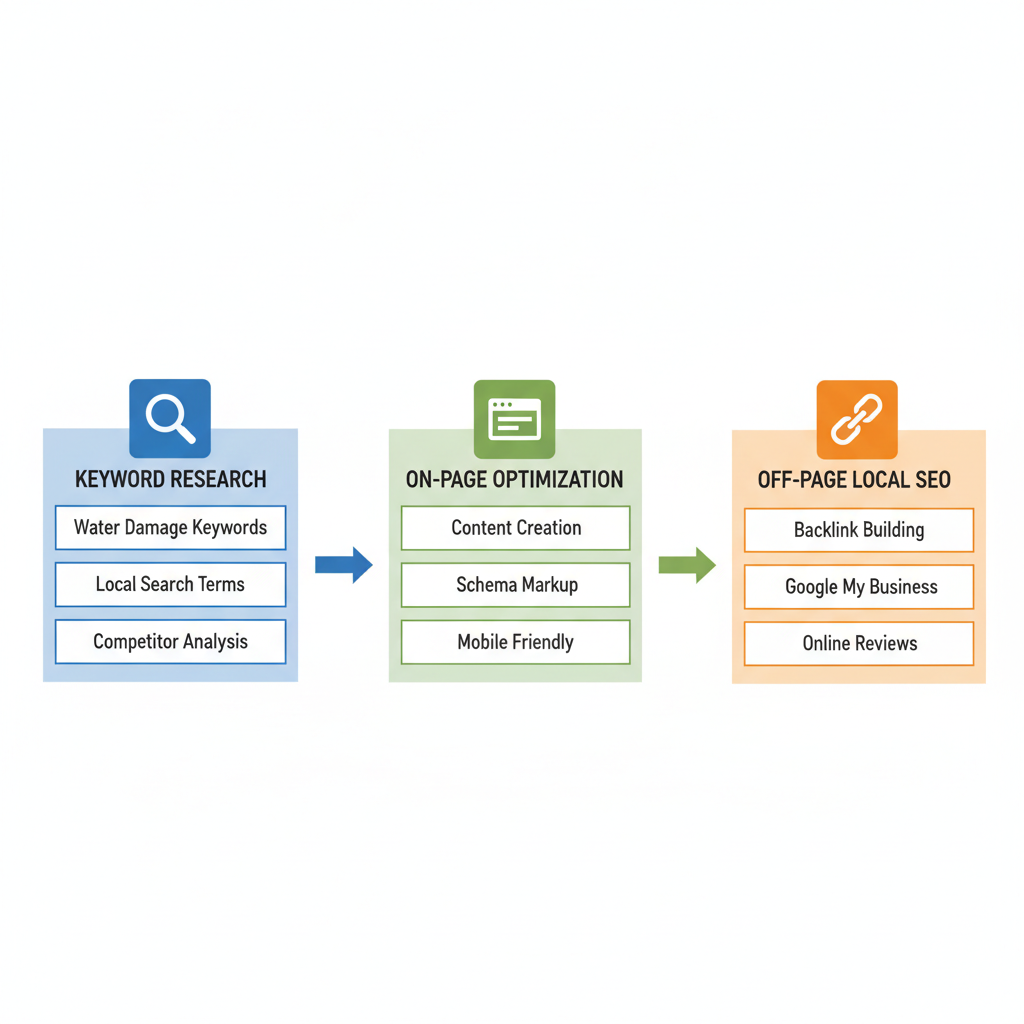
Illustrated process for implementing water damage SEO strategy
This foundational overview sets the stage for diving into each component, ensuring readers grasp the full SEO workflow for floods and beyond.
Step-by-Step Keyword Research and Targeting
- Begin with free tools like Google Keyword Planner to identify search volume and competition for terms such as emergency water damage restoration. Enter seed phrases related to your services and filter for local intent.
- Analyze competitors by reviewing top-ranking pages for water damage restoration; note gaps in content coverage, like detailed restoration timelines that answer how long water damage restoration typically takes.
- Prioritize high-value keywords with moderate competition, such as variations of water damage restoration, focusing on long-tail phrases that signal user urgency, like steps in water damage restoration after a flood.
- Compile a list of 10-20 primary and secondary keywords, including semantic variations like SEO workflow for floods, and validate with tools like SEMrush for monthly searches.
Why It Matters: Effective keyword targeting directly boosts rankings, drawing in users searching for immediate help and paralleling the rapid response needed in actual restoration to minimize damage and costs.
Tips: Avoid keyword stuffing by limiting each term to once per page; always cross-check with real user questions, such as what are the steps in water damage restoration, to ensure relevance.
On-Page and Content Optimization Techniques
- Create dedicated service pages optimized for core terms like water damage restoration, incorporating the keyword naturally in titles, headers, and meta descriptions to highlight urgency-focused content.
- Develop blog posts around restoration steps and costs, such as guides on the water damage restoration process, using H2 tags for subtopics and internal links to service pages.
- Optimize images and alt text with keyword variations, ensuring mobile-friendly design and fast load times to improve user experience and search signals.
- Implement schema markup for local services to enhance rich snippets, making pages stand out for queries on optimization steps for restorers.
Why It Matters: On-page tweaks ensure search engines understand your content’s relevance, driving higher rankings and conversions for restoration queries, much like precise cleanup in restoration prevents escalation.
Tips: Use short paragraphs and bullet points for readability; test pages with Google’s Mobile-Friendly Tool and update content quarterly to maintain freshness without over-optimization.
Off-Page and Local SEO Implementation
- Set up and verify Google My Business, optimizing the profile with photos, services, and keywords like water damage restoration services near me in flood-prone regions to target local searches.
- Build citations on directories such as Yelp and Angi, ensuring consistent NAP (name, address, phone) data; reference proven guides on citations for local SEO to avoid duplicates.
- Acquire quality backlinks through guest posts on industry sites and partnerships with related businesses, focusing on authoritative domains in home services.
- Monitor progress with Google Analytics and Search Console, tracking rankings for local terms and adjusting based on performance metrics over 3-6 months.
Why It Matters: Off-page efforts establish local dominance, increasing visibility for nearby leads and mirroring the community trust built in restoration services to foster quick responses.
Tips: Prioritize ethical link-building to evade penalties; schedule monthly audits of citations and engage with reviews to boost credibility in your area.
Proven Strategies for Water Damage SEO Success
Implementing effective water damage SEO requires a blend of advanced tactics tailored to the restoration industry’s unique challenges, such as urgent emergency searches and local competition. Businesses focusing on water damage SEO can achieve significant lead growth by prioritizing user-centric strategies that address immediate needs like rapid response times and trust-building elements. This section explores proven approaches to elevate your online presence, from content optimization to integrated marketing, ensuring sustainable results in a competitive landscape.
Advanced Content and Review Management
Creating high-quality, mobile-first content is essential for capturing emergency queries in water damage restoration. Focus on educational pieces that explain processes like water extraction and drying techniques, optimized for quick loading on smartphones since most users search during crises. Develop blog posts on topics such as preventing secondary damage from mold, incorporating semantic variations like advanced flood SEO tips to broaden reach without keyword stuffing.
Leveraging reviews builds authority for water damage restoration services near me searches. Respond promptly to all feedback, highlighting positive experiences with specifics like 24-hour service, to foster trust and improve local rankings. Use bolded checklists for best practices:
- Audit content quarterly: Ensure mobile responsiveness and update with seasonal flood advice.
- Encourage reviews post-job: Aim for 50+ monthly to boost ‘near me’ visibility.
- Monitor sentiment: Address negatives within 24 hours to maintain a 4.5+ star rating.
These steps can yield a 25% increase in organic traffic within six months, directly tying to better lead conversion for restoration firms.
Budgeting and Measuring SEO Performance
Effective budgeting for water damage SEO starts with allocating resources based on revenue, recommending 5-10% of total marketing spend, or $500 to $2,000 monthly for small to mid-sized restorers. Avoid vague approaches by setting clear percentages for key components, scaling up during flood seasons to capture heightened search volumes. Integrate performance metrics for restorers like bounce rates and conversion tracking to justify investments and refine tactics.
Set up Google Analytics early to monitor key indicators, such as session duration and goal completions for inquiry forms. Track metrics like a 20% traffic uplift from optimized pages, adjusting budgets quarterly based on data insights. Implementation tip: Use free tools initially, then invest in premium software as ROI becomes evident, ensuring every dollar drives measurable lead growth.
The following table outlines a recommended SEO budget breakdown for restoration companies, drawing from industry pricing insights to provide concrete guidance over ambiguous estimates.
| SEO Component | Recommended Spend (%) | Expected ROI |
|---|---|---|
| Keyword Research & Tools | 10-15% | 20-30% lead increase in 3 months |
| Content Creation | 30-40% | Ongoing traffic growth |
| Technical Audits | 20-25% | Improved site speed and rankings |
This allocation emphasizes content as the cornerstone, responsible for up to 50% of SEO success in service sectors, while technical audits prevent pitfalls like slow load times that deter emergency users. Scalable spends allow firms to start modestly and expand, correlating higher investments with 300% lead boosts over time, aligning budgets with revenue goals for long-term efficiency.
Integrating SEO with Broader Marketing
Combining water damage SEO with paid channels like PPC creates a hybrid approach that accelerates visibility during peak flood periods. Run targeted Google Ads for high-intent terms alongside organic efforts, ensuring consistent messaging across platforms to nurture leads from awareness to conversion. For water damage restoration examples, integrate social media posts showcasing before-and-after projects to drive traffic back to optimized landing pages.
Address relevant concerns like choosing reliable services by emphasizing review integration in ads, which can prevent issues such as mold growth through timely interventions. Seasonal adjustments, like boosting budgets in rainy months, maximize ROI. Bolded checklist for integration:
- Sync campaigns: Align ad copy with SEO keywords for unified branding.
- Use retargeting: Follow up site visitors with social ads for 15% conversion lift.
- Measure holistically: Track cross-channel attribution to optimize spend.
This comprehensive strategy not only answers cost queries by demonstrating value through data but also positions your business as a trusted partner, setting the stage for sustained success in competitive markets.
Unlocking Sustainable Growth with Water Damage SEO
In the competitive world of restoration services, mastering water damage SEO emerges as a game-changer for generating consistent leads. By implementing the fundamentals, benefits, and best practices outlined in this guide–from targeted keyword strategies to local optimization–you can elevate your visibility and attract urgent inquiries for water damage restoration. Remember the processes for on-page enhancements and off-page authority building, along with practical tips for budgeting wisely to avoid common pitfalls like underfunding your campaigns. These elements not only drive SEO-driven restoration success but also ensure real leads from searches like water damage restoration services near me in key markets.
Key Takeaways
- Prioritize ‘water damage restoration’ keywords to dominate local search results and respond quickly to emergencies.
- Allocate budgets strategically, aiming for sustainable investments that yield 300% lead growth as seen in industry success stories.
- Focus on lead generation optimization to convert visibility into booked jobs, preventing errors like ignoring mobile responsiveness.
Ready to transform your restoration business? Growth Pro Agency, built by contractors for contractors, offers a free 30-minute strategy session to craft a tailored water damage SEO roadmap. With our AI automations and technical expertise, we’ve driven measurable results for home services pros nationwide. Contact us today to unlock sustainable growth and dominate your local market.